

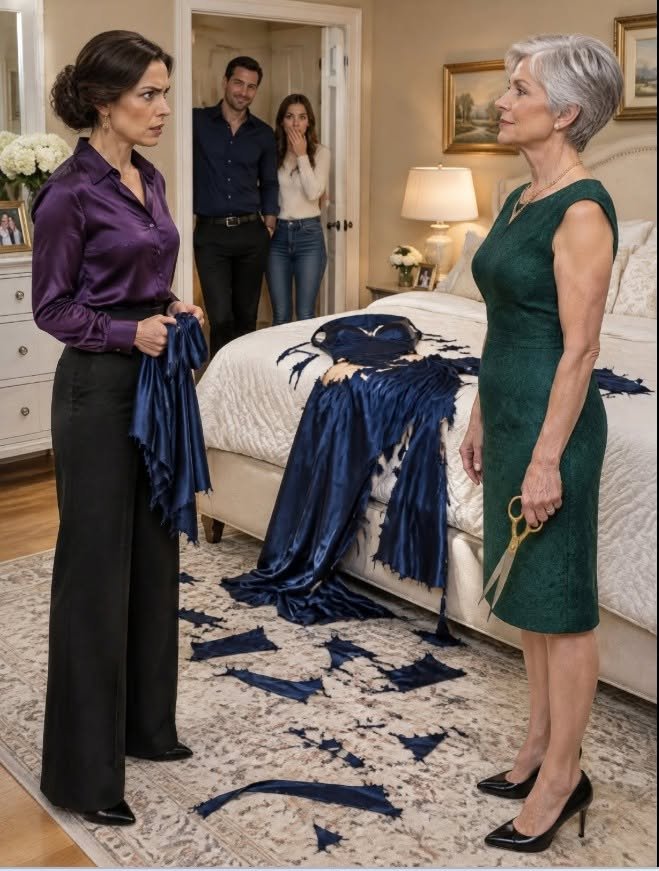
“Because I’m leaving.”
“For where?”
“The ceremony.”
Mark appeared from the kitchen carrying a bottle of wine. His expression tightened immediately when he realized I had no intention of staying.
“Mom already told everyone you were handling dinner.”
I looked at Patricia.
“Then she has created a very interesting evening for herself.”
One of Patricia’s friends offered me a hesitant congratulations, but Patricia dismissed the event as “some award thing.” I picked up my purse and headed for the door while Mark asked what they were supposed to do about dinner.
“Order something.”
“For twelve people?”
“Yes.”
Patricia stared at me.
“What am I supposed to order?”
“I hear restaurants sell food now.”
Mark called me childish, and for once I did not try to soften my answer.
“No, Mark. Cutting up someone’s clothes because you want pot roast is childish.”
I walked out without giving a speech or waiting for permission. Twenty minutes later, however, I pulled into a Walgreens parking lot and nearly turned around.
My hands were cold against the steering wheel as all the familiar arguments returned. Patricia’s guests were already there, Mark was furious, Melissa would hear about it, and everyone would probably say I had embarrassed the family.
I was fifty-two years old, ran a nonprofit, managed employees, answered to a board, and controlled a substantial budget. Yet there I was, afraid to attend my own award ceremony because my mother-in-law wanted green beans.
Then my phone rang.
“Clare, where are you?”
“Almost there.”
Denise was silent for a moment.
“You pulled over, didn’t you?”
I closed my eyes.
“How did you know?”
“Because I know you.”
I admitted I was considering going back because maybe I had made too much of everything. Denise reminded me that Patricia had deliberately destroyed my dress and that Mark’s anger did not make the behavior acceptable.
“Clare, that part of you that wants to turn around has been driving for twenty-three years.”
I gave a weak laugh.
“That’s very poetic.”
“I’m not finished.”
“Of course you’re not.”
“Let somebody else drive for ten minutes.”
Then she reminded me that she had spent forty dollars dry-cleaning the dress and expected a return on her investment. I laughed for the first time all day, started the car, and continued downtown.
The theater lobby was busy when I arrived, but the ordinary routine helped settle me. I signed forms, collected my badge, sat through a makeup touch-up, and followed instructions for the sound check until Patricia and Mark finally stopped occupying every corner of my mind.
At 5:18, Sam Ortega, the event producer, appeared and asked whether I was ready to meet my presenter.
“Now?”
“Now.”
He led me through a backstage hallway and stopped outside a dressing room. I expected a foundation president or perhaps a well-known nonprofit executive.
Instead, when the door opened, I recognized the silver-haired woman standing inside immediately.
Evelyn Grant.
Patricia owned nearly every movie she had ever made.
Evelyn smiled when she saw me.
“Clare Whitmore. I’ve wanted to meet you for a long time.”
I stared at her.
“I’m sorry?”
She invited me to sit and then explained why she knew my name.
“My sister knew you.”
“Your sister?”
“Margaret Bell.”
The name brought everything back immediately. Margaret had been sixty-one when she came to Second Chapter House after spending three decades outside the workforce, terrified that no employer would take her seriously.
I remembered sitting with her outside a job interview while she gripped her purse and told me she was certain they would reject her because of her age.
“They’re going to take one look at me and send me home.”
“Then let them look twice.”
Margaret went inside, and I waited in the parking lot for nearly two hours because she was afraid to come out alone if the interview went badly. She got the job.
Evelyn told me Margaret had remembered that day for years.
“She died eighteen months ago.”
I lowered my eyes.
“I’m so sorry.”
Evelyn nodded before continuing.
“Before she died, she told me you gave her life back without ever making her feel foolish for losing it.”
The words hit harder than I expected. My fingers instinctively twisted the blue strip around my wrist, and Evelyn noticed.
When she asked about it, I briefly explained the ruined gown, Patricia’s dinner, and Mark’s reaction. Evelyn listened without interrupting.
When I finished, she looked at the fabric and then back at me.
“Tonight isn’t about proving anything to them.”
I nodded slowly.
“Then what is it about?”
She leaned back in her chair.
“Let them do their own arithmetic.”
For the first time all day, I thought I might actually be able to.
PART 4: THE NIGHT THEY FINALLY SAW WHAT MY WORK MEANT
Back at Patricia’s house, dinner apparently became a disaster almost immediately. Without me there, nobody seemed to know where the serving bowls were, which drawer held the good silverware, or what to do when one guest asked for decaf and another needed a chair with better back support.
By 6:30, Mark gave up and ordered takeout. Patricia blamed me for leaving her with twelve guests, but one of her friends quietly reminded her that she had been the one who invited them.
Around 7:30, someone finally asked what time my award ceremony started. When Melissa mentioned Second Chapter House, one of the guests searched the organization online and found the event page.
“This isn’t some little church award.”
Mark took the phone and saw my photograph beside the broadcast information. According to Melissa, that was the moment he stopped complaining about dinner.
At eight o’clock, someone turned on the television.
I knew none of this while sitting backstage trying not to ruin Denise’s dress with nervous sweat. When the host returned to the microphone, he announced that the National Second Chance Award honored fourteen years of extraordinary service to women rebuilding their lives.
Then he introduced the presenter.
“Please welcome Academy Award-winning actress and humanitarian Evelyn Grant.”
The theater erupted in applause. Somewhere across town, Patricia stopped talking.
Evelyn walked onto the stage and waited for the room to settle. Instead of beginning with my résumé or Second Chapter House, she started talking about her younger sister.
“My sister’s name was Margaret Bell.”
My breath caught immediately.
Evelyn explained that Margaret had been sixty-one when she left a marriage where almost every financial decision had been made for her. She had not interviewed for a job in more than thirty years and believed she should have been ashamed for needing help at her age.
Then Evelyn described the morning Margaret sat in a car outside an interview, terrified the employer would reject her immediately.
“She told the woman beside her, ‘They’re going to take one look at my age and send me home.’”
I knew what was coming before she said it.
“The woman answered, ‘Then let them look twice.’”
Denise squeezed my hand.
Evelyn told the audience that I had waited in that parking lot for nearly two hours because Margaret was afraid to come back outside alone if the interview went badly. I had almost forgotten those two hours because, to me, it had simply been part of the work.
“No camera recorded that. Nobody applauded Clare in that parking lot.”
She paused.
“But my sister remembered.”
Evelyn explained that Margaret got the job and remained there for five years. Before she died, she had told her sister something Evelyn said she would never forget.
“There is a difference between being needed and being respected.”
The words hit me with unexpected force.
Evelyn spoke about women who spend their lives being useful to everyone around them. People depend on their cooking, patience, money, time, and emotional labor, but the moment those women ask for something of their own, the same people often accuse them of becoming selfish.
Nobody in the theater knew about my ruined gown.
