

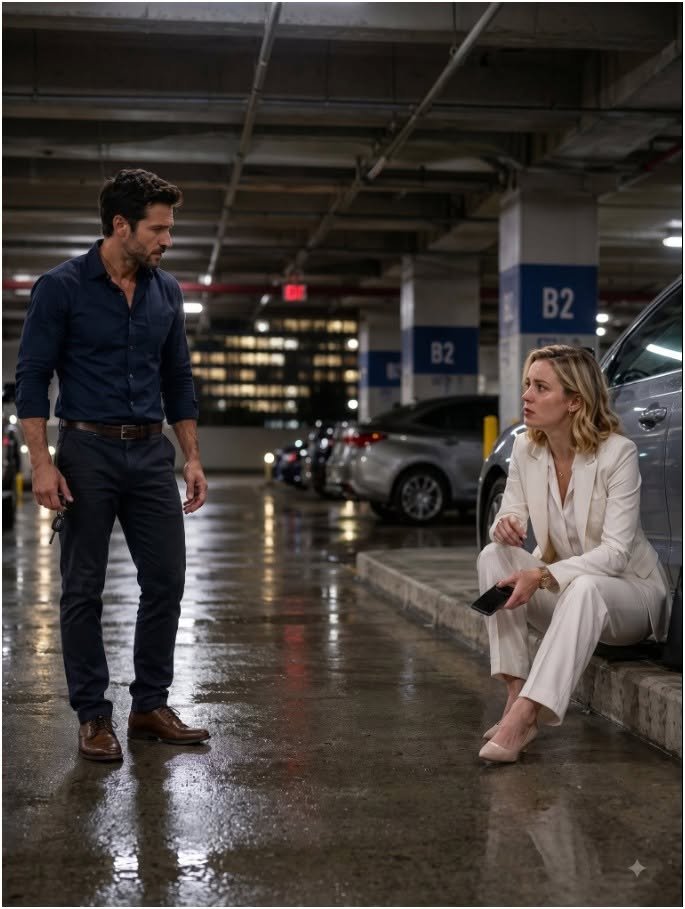
Emily smiled. “I am. The really big boss.”
“Mia.”
“What? You said she was the chief executive officer.”
Emily crouched slightly so they were closer to eye level. “Your father is correct.”
Mia considered this. “Is he good at his job?”
Ryan started to speak, but Emily answered first. “One of the best.”
The words were simple. Still, Ryan went quiet. Praise was common in corporate offices when someone wanted something. This felt different. Emily had said it to the one person whose opinion mattered most to him.
Mia nodded with satisfaction. “I knew that.” Then her eyes narrowed. “Have I seen you before?”
Emily’s smile faded by half a degree. Ryan noticed.
“I do not think so,” Emily said carefully.
Mia tilted her head, studying her. “Maybe in a picture.”
Hannah suddenly became very interested in the folder she was holding. Ryan caught the movement. Before he could ask, Mia reached into her backpack and pulled out a bright yellow flyer.
“My school is having a fundraiser Thursday. There will be cupcakes and a raffle and terrible singing.”
“The singing is not advertised as terrible,” Ryan said.
“I heard rehearsal.”
Emily laughed. Mia held out the flyer. “You should come.”
Ryan gently lowered Mia’s hand. “Sweetheart, Ms. Parker is busy.”
“Thursday at 6:30?” Emily asked.
Mia nodded.
Emily looked at Ryan. “I can make 6:30.”
Ryan stared at her. “You do not have to.”
“I know.”
That answer stayed with him.
Thursday evening, Ryan stood inside Maple Grove Elementary beneath paper stars and handmade banners, helping Mia arrange cupcakes when the gymnasium doors opened. Emily walked in alone. No assistant. No driver waiting beside her. Jeans, a blue sweater, blonde hair loose over her shoulders. For several seconds, Ryan barely recognized her.
Mia did. “You came!” she shouted, racing over.
Emily smiled as Mia took her hand and pulled her toward the tables. Ryan watched from across the room, something warm and cautious moving through him.
Later, while Mia sold raffle tickets, Emily stopped beside a display of student drawings. One picture made her completely still. It showed a little girl standing between a brown-haired man and a blonde woman beneath three uneven stars. In the corner, written in a child’s careful handwriting, were the words: “People who need a second chance.”
Emily touched the edge of the paper. “Ryan,” she whispered.
He stepped beside her. “What is it?”
Emily looked toward Mia, who was laughing 20 ft away. Then she asked a question that made the noise of the crowded gym seem to disappear. “When did Mia draw this?”
Ryan checked the date beneath the picture. “3 weeks ago.”
Emily’s face lost its color. 3 weeks ago was before the parking garage, before the missed dinner, before Ryan had supposedly entered her life at all.
Across the gym, Hannah Reed quietly appeared through the doors, saw the drawing in Emily’s hand, and stopped walking. Hannah did not move until Emily looked directly at her. For one long second, the three adults stood separated by 20 ft of folding tables, paper stars, and families buying cupcakes for $2 a piece. Ryan felt the change immediately.
“Hannah,” Emily called.
Hannah approached slowly. Mia was still busy selling raffle tickets, unaware that her drawing had turned an ordinary school fundraiser into something else entirely.
“You knew about this,” Emily said.
Hannah glanced at Ryan, then at the picture. “I knew about the drawing.”
Ryan’s voice remained calm. “Would somebody tell me what is happening?”
Hannah exhaled. “Mia entered a district art project last month. The theme was second chances.”
Ryan looked toward his daughter. “She never told me.”
“Because she wanted it to be a surprise.” Hannah reached into her purse and removed a small envelope. “Westbridge sponsored the project.”
Emily stared at her. “And you judged the finalists.”
The memory returned to Emily all at once. A conference room, 20 children’s drawings, one picture she had studied longer than the others. Three figures beneath uneven stars. She had never known the child’s last name because entries were coded for anonymous judging.
“Mia was entry 17,” Emily whispered.
Hannah nodded.
Ryan looked between them. “Then why did Mia recommend me?”
Hannah almost smiled. “She did not recommend you to Emily. She recommended Emily to you.”
Ryan went still. Hannah explained that after Mia’s drawing was selected, she had recorded a short thank you message for the sponsor. During that recording, Mia had asked who chose her picture. Hannah had answered only that it was a woman named Emily who worked at Ryan’s company. Mia had apparently remembered more than anyone expected.
“She told me her dad needed a second chance, too,” Hannah said softly. “Then she asked if Emily was nice.”
Ryan rubbed a hand across his jaw. “And from that, you arranged a blind date.”
“Not from that alone. I knew Ryan from employee volunteer events. I knew Emily. I thought two good people might survive one dinner.”
Emily looked at the drawing again. “So, the blue star in your message…”
“Mia’s entry number.”
Ryan finally understood the words he had seen in the parking garage: “Recommended by Mia.” Not some secret connection. Not manipulation. Just a 7-year-old girl making an innocent observation adults had turned into possibility.
Across the gym, Mia waved proudly at them. Ryan waved back. Emily’s eyes softened.
“She drew this before she knew me.”
“Children draw what they hope for,” Hannah said. “Adults usually wait until hope feels safe.”
The words settled quietly between them. But safety did not last long.
By Friday morning, someone at WestBridge had seen Emily at the fundraiser. By noon, whispers were moving through the executive floor. By 3:00, Ryan entered the break room and heard his own name stop a conversation.
“Do not stop because I walked in,” he said.
A senior director named Grant Keller leaned against the counter, coffee in hand. “Nobody said anything.”
“Then there is no problem.” Ryan turned toward the door.
Grant smiled. “Smart move, Mitchell.”
Ryan stopped. “What is?”
“Getting close to the chief executive officer right before the operations restructuring.”
The room became silent. Ryan turned slowly. “I have not asked Emily Parker for anything.”
Grant lifted his cup. “You might not have to.”
Ryan did not argue. He did not raise his voice. He simply walked out. But dignity sometimes carries a heavier price than anger. 10 minutes later, Ryan opened the staffing portal and withdrew his name from the upcoming senior operations project.
When Emily received the automated notification upstairs, she called him immediately. “Why did you withdraw?”
“Because Mia is watching the kind of man I become.”
“Ryan, you earned that assignment.”
“Then I need to earn it where nobody can say your feelings gave it to me.”
Emily fell silent. For the first time, she understood that her power could protect his career and damage his dignity at the same time.
Ryan’s voice softened. “I will not teach my daughter that respect is something borrowed from the person who likes you.”
Then the call ended, leaving Emily alone with a truth no title could solve.
Emily did not call Ryan again that Friday. She wanted to. Twice she reached for her phone and twice she stopped. Ryan had not asked to be rescued. He had asked for the one thing power could not simply hand him, respect without suspicion. So Emily did something that surprised even Hannah. She stepped away.
On Monday morning, WestBridge employees received notice that the senior operations project would be assigned through an independent review led by an outside consulting firm. Names would be removed from performance records during the first evaluation. Emily would not vote. Neither would Grant Keller.
“You are removing yourself from your own restructuring decision,” Grant asked during the executive meeting.
Emily closed the folder in front of her. “I am removing doubt.”
“That seems excessive.”
“Only if the process cannot survive transparency.”
Grant said nothing.
Three days passed. Ryan worked as if nothing had changed. He repaired a malfunctioning access system, covered a shift for a technician whose son had a school concert, and ate lunch at his desk while Mia’s purple crayon drawing remained taped beside his monitor. He never asked Emily about the review. He never asked Hannah.
On Thursday afternoon, the outside consultants requested Ryan’s complete employment history. What they found surprised almost everyone except Ryan. Two years earlier, his former supervisor had recommended him for facilities manager. Ryan declined because the position required frequent overnight travel. 11 months later, he had been nominated for regional operations lead. He declined again because the schedule would have kept him away from Mia several weekends each month.
There was more. Ryan had designed an energy-saving maintenance schedule that reduced annual building costs by nearly $90,000. His supervisor had received most of the public credit. Ryan had never corrected anyone.
When Emily read the report, she remained silent for a long time. “He never told me any of this,” she finally said.
Hannah stood near the window. “Would you have believed him more if he had?”
Emily looked down at the pages. “No, that is probably why he did not.”
Friday morning, the review committee assembled in the 12th floor conference room. Ryan had been asked to attend but had not been told why. Grant sat near the far end of the table, expression unreadable. Emily sat apart from the voting members.
The lead consultant opened a folder. “We evaluated 11 candidates using performance history, peer feedback, cost efficiency, leadership records, and documented operational outcomes.”
Ryan folded his hands calmly.
“The highest score belonged to Ryan Mitchell.”
Silence settled across the room.
The consultant continued, “by a substantial margin.”
Grant shifted in his chair. “Given recent circumstances, surely perception matters.”
Ryan looked down briefly. Emily did not move.
The consultant turned another page. “The recommendation predates any documented personal interaction between Mr. Mitchell and Ms. Parker.”
Then Hannah placed two older personnel forms on the table. “Actually, his first promotion recommendation predates it by 2 years.”
Grant stared at the documents. Ryan stared, too. He had not known those records still existed.
Emily wanted to speak, but she remembered the parking garage, the cold concrete, the dignity Ryan had offered her without asking for anything in return. So, she remained quiet. This moment belonged to his work, not her feelings.
The committee voted. Unanimous. Ryan was offered leadership of the senior operations project on merit alone.
Afterward, employees filtered into the hallway until only Ryan and Emily remained several feet apart.
“You did not defend me,” he said.
Emily searched his face, uncertain whether he was hurt. “You asked me not to make your respect dependent on mine.”
Ryan nodded slowly. “So, you listened.”
“I am learning.”
For the first time all week, he smiled. Then he noticed something through the glass wall behind her. On the conference table, beneath the old promotion records, lay a photocopy of Mia’s drawing. In the lower corner was a handwritten date Ryan had never seen before, along with another name.
Emily followed his gaze and immediately went still. The handwriting was not Mia’s. And the date was almost 1 year before Mia had supposedly created the picture.
Ryan stepped back into the conference room and picked up the photocopy. Beneath the three uneven stars, almost hidden by the copier shadow, someone had written a date from 11 months earlier and two words: Parker Foundation.
“Emily.” His voice was quiet.
She took the page from him and the color drained from her face. “I know this handwriting.”
Hannah, still gathering folders near the door, stopped.
Emily traced the faded words with one finger. “It was my mother’s.”
Ryan looked at her. “Your mother?”
Emily nodded slowly. “She ran the Parker Foundation before she passed away last year. Education grants, school meals, community programs. She reviewed hundreds of children’s projects.”
Hannah came closer. “That explains the date, but not the drawing.”
Emily studied the image. Three figures. A brown-haired man. A blonde woman. A little girl beneath three stars.
“This is not Mia’s original drawing,” Ryan said. “She copied something.”
The realization landed gently, but heavily.
That evening, Ryan asked Mia about it at home. She sat at the kitchen table eating macaroni and cheese while the photocopy rested beside her purple backpack.
“Where did you see this picture, sweetheart?”
Mia looked at it and immediately smiled. “At school.”
“When?”
“Last year. Mrs. Dawson had it on the kindness wall.”
Ryan crouched beside her chair. “Why did you draw it again?”
Mia shrugged with the uncomplicated honesty of a child. “Because I liked what the lady wrote.”
“What lady?”
“The lady in the picture book.”
Ryan exchanged a look with Emily, who had come only because the question now belonged to both of them. Mia disappeared into her room and returned carrying a thin paperback from the school library. Inside was a collection of student art funded by the Parker Foundation. Near the back was the original picture drawn years earlier by another child. Beneath it was a short printed note from Emily’s mother: “Sometimes the family we need arrives after the family we imagine changes.”
Emily stopped breathing for a moment. Ryan said nothing. He simply moved the book closer to her.
Mia pointed proudly at the page. “I thought Dad needed that.”
Emily looked at Ryan, then at Mia. The mystery was smaller than fate and somehow more meaningful. No secret plan. No impossible prophecy. A child had found a hopeful sentence, copied a picture, and unknowingly carried one woman’s kindness back to that woman’s daughter.
The following Monday brought a different kind of reckoning. During the executive review, Grant again raised concerns about Ryan’s appointment. “Whatever the committee decided, employees are talking. Personal relationships create questions.”
This time Emily stood. “Then let us answer them.”
The room quieted.
“Ryan Mitchell did not approach me for advancement. He did not ask for access, influence, or favor. His record established his qualifications years before I knew him personally.”
Grant opened his mouth, but Emily continued. “And since perception seems important, there is one fact everyone should understand.” She looked across the table at Ryan. “He never came looking for me.”
Silence settled over the room.
“I was the one sitting alone.”
Ryan’s expression changed. Emily’s voice remained steady.
“He found me during one of the worst evenings of my life. He could have used that moment. He could have told co-workers. He could have tried to impress me. Instead, he protected my dignity and walked away expecting nothing.”
No one moved.
“That is not ambition,” she said. “That is character.”
Grant lowered his eyes. Emily did not smile. She had not humiliated him. She had simply placed the truth where everyone could see it.
Later, outside the conference room, Ryan found her standing by the windows. “You defended me this time.”
“No,” Emily said softly. “Your record defended you. I only told them who defended me.”
Ryan looked at her for a long moment. Then Emily handed him the old picture book. A small paper marker rested between its pages. Ryan opened it and found another note written by Emily’s mother beside the original artwork, one Mia had apparently never noticed. Ryan read the first line, then looked up in stunned silence. Emily had not read it yet. And suddenly, the strange path connecting a little girl, a forgotten drawing, and one Friday night in a parking garage was not finished revealing itself.
Ryan held the book beneath the hallway lights and read the handwritten sentence again: “If this picture ever finds its way back to my daughter, tell her that love is not the person who completes her life. It is the person beside whom she can finally stop pretending to be complete.”
Emily stared at him. “My mother wrote that.”
Ryan turned the book toward her. The handwriting was faded blue ink, gentle and slightly uneven. Emily touched the edge of the page but not the words themselves. For several seconds, the chief executive officer who could answer investors without hesitation could not speak.
“She worried about me,” Emily finally whispered. “Even when she was sick, I kept telling her I was fine. Work was fine. Everything was fine.”
Ryan closed the book carefully. “Maybe she knew.”
Emily gave a fragile smile. “Mothers usually do.”
Three weeks passed. Ryan accepted leadership of the senior operations project after the independent committee finalized its decision. Emily kept her distance at work, not because the connection between them had disappeared, but because both understood that something worth protecting should never require someone else’s dignity as payment. They spoke in meetings. They exchanged occasional smiles in hallways. Nothing more.
Then on a Friday afternoon, Ryan received a text from Hannah: “Bellini House, 8:00. Wear the navy shirt.”
Ryan stared at the message. Mia, eating apple slices across the kitchen table, looked suspiciously innocent.
“Do you know something?”
“Maybe.” Mia grinned. “Wear the navy shirt, Dad.”
At 7:58, Ryan entered Bellini House. Warm pendant lights glowed above familiar tables. Soft piano music drifted across the room. He sat in the same chair where he had once waited 47 minutes for someone who never arrived.
8:00 passed. 8:03. 8:05. Ryan looked toward the entrance and smiled to himself. “History has a sense of humor,” he murmured.
At 8:06, Emily walked through the door. No business suit, no assistant, no title following behind her. Just jeans, a simple cream sweater, blonde hair loose over her shoulders, and a nervous smile Ryan had never seen in the boardroom. She stopped beside the empty chair. “Is this seat taken?”
Ryan glanced at his watch. “I was starting to think history was repeating itself.”
“Not tonight.” She sat down.
For the next hour, they talked about everything except WestBridge. Mia’s science project, Emily’s terrible cooking, Ryan’s dream of someday restoring an old farmhouse. Emily admitted she had never learned how to change a tire.
“That feels irresponsible,” Ryan said.
“I run a technology company. Cars remain unconvinced by your resume.”
She laughed. It was easy now. Quiet. Human.
When dessert arrived, Emily reached into her purse and placed the old Parker Foundation book on the table. “I found something else,” she said.
From the back cover, she removed a small photograph. Ryan recognized Emily’s mother immediately from company memorial photographs, but she was not alone. Standing beside her at a WestBridge community volunteer event was a younger Ryan, nearly 4 years earlier, holding toddler Mia in his arms.
Ryan stared. “I remember that day.”
Emily turned the photograph over. On the back, her mother had written: “Name, Ryan Mitchell.” Beneath it were six words: “A good father. Do not forget.”
Emily’s eyes filled. “Hannah found this in my mother’s Foundation files yesterday.”
Ryan looked from the photograph to Emily. The restaurant seemed to fade around them. Four years earlier, long before the drawing, long before Hannah arranged dinner, long before a missed date sent two lonely people into the same parking garage, Emily’s mother had noticed him.
“So Hannah did not choose me randomly,” Ryan said.
Emily shook her head. “No, the truth arrived quietly.”
After Emily’s mother passed away, Hannah had found a sealed folder labeled “Second Chances.” Inside were several notes about people Mrs. Parker believed possessed the kind of character her daughter had stopped believing existed. Ryan’s name was first. Mia’s art project had not created the connection. It had reminded Hannah of one already waiting in that folder.
Ryan sat speechless. Emily reached across the table and rested her hand gently over the photograph.
“My mother did not choose my future,” she said. “She just left me a reason to look up when it finally walked past.”
Ryan smiled. Outside, Friday traffic moved beneath the city lights. Inside, two people who had once been left waiting were no longer waiting at all. And perhaps that was the quiet grace of second chances. They rarely return what was lost. Sometimes they reveal that while you were mourning the wrong door, someone who loved you had already left a light beside the right one.
