

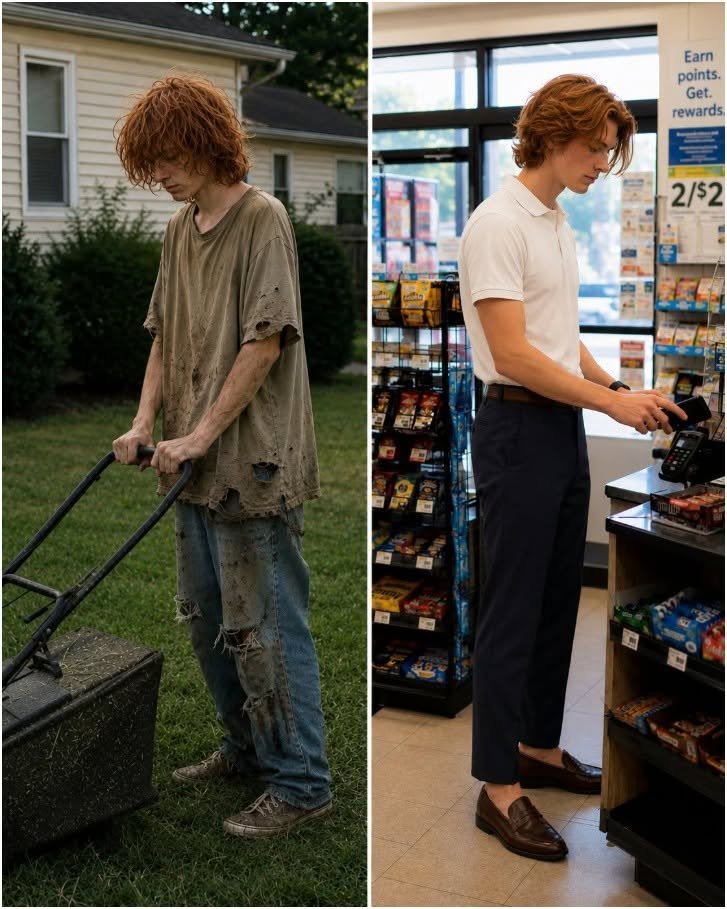
“I…”
“You asked if I keep the garage locked now.”
He looked toward the open garage before meeting my eyes again.
“I should go.”
“Chase.”
He stopped.
“If you don’t tell me what’s going on, don’t come back.”
For a long moment, he didn’t move. Then he whispered, “I’m sorry.”
He turned off the mower, lowered the handle, pushed it down the driveway, and disappeared around the corner.
He never asked for his pay.
That bothered me almost as much as what he’d said.
For the next week, I couldn’t stop thinking about the garage.
How did a 15 year old know it had ever been unlocked?
The following Saturday came and went.
No Chase.
The grass grew taller.
The Saturday after that, I accepted that he wasn’t coming back.
Three days later, I was leaving the grocery store when I spotted him climbing into the passenger seat of a brand new black SUV.
For a second, I thought I’d mistaken him for someone else.
The faded cap was gone.
So were the patched jeans and worn sneakers.
He wore a designer polo shirt, spotless white shoes, and a watch that looked absurd on someone his age.
Then he looked up.
It was definitely Chase.
The SUV pulled away before I could call his name.
I stood there watching it disappear, wondering if I’d imagined everything he’d told me.
The next Saturday, there was another knock at my door.
I opened it to find Chase standing there with the old mower.
He looked exhausted.
“I know you told me not to come back.”
“I did.”
“I wanted to explain.”
I stepped aside.
“Then explain.”
He didn’t sit.
He stood in my living room, twisting his cap between his hands.
“The man in the SUV…”
“My dad.”
I waited.
“I live with my mom. The judge says I have to stay with him every other weekend.”
I frowned.
“So the clothes…”
“They stay at his house.”
He gave a small shrug.
“I call them my weekend clothes.”
He tried to smile.
It didn’t last.
“My dad likes people to think he takes care of me.”
“And does he?”
“He buys expensive stuff.”
He looked down at the cap in his hands.
“I’d rather have him show up to one of my baseball games.”
The room fell silent.
“So why were you mowing my lawn?”
He closed his eyes.
“Because I wanted to be here.”
He opened them again.
“My family used to own your house.”
Everything clicked into place.
“The garage.”
He nodded.
“My grandpa built the workbench. I learned to ride my bike on that concrete floor. When it rained, we’d sit in there and listen to the roof.”
His voice cracked.
“After Grandpa died, everything fell apart. My mom couldn’t keep the mortgage. We lost the house.”
“When was this?”
“Three years ago.”
“And your father?”
“He wasn’t around.”
I remembered the expensive SUV.
“He had the money?”
“He always had money. But he fought helping us.”
The bitterness in his voice was quiet.
That somehow made it hurt more.
“When the court finally ordered child support, it was too late.”
“We’d already packed everything.”
He swallowed.
“I kept riding my bike past the house. Then I saw the ‘For Sale’ sign. When you moved in, I figured…” He laughed softly at himself. “I figured if I couldn’t live here anymore…”
He looked toward the garage.
“…maybe I could still take care of it.”
“You asked for the mowing job.”
“It was the only reason.”
“You weren’t looking for work.”
“I was looking for home.”
Neither of us spoke for several seconds.
Finally I asked, “What happened the day I found you in the garage?”
“I sat at Grandpa’s workbench. That’s all. I remembered where everything used to be.”
He looked embarrassed.
For illustrative purposes only
“When I walked up, and the door was locked…” He shook his head. “I forgot it wasn’t ours anymore.”
Those words landed harder than anything else he’d said.
I forgot it wasn’t ours anymore.
“You didn’t take anything.”
“I didn’t want anything. I missed my grandpa.”
I believed him.
Every word.
“I’m sorry I lied.”
“You should’ve told me.”
“I was afraid you’d say no.”
“I probably would’ve.”
“I know.”
That made us both laugh.
The tension finally eased.
“Go mow the lawn,” I said.
“You still want me to?”
“I’ve got a feeling you’re the only person who actually cares how it looks.”
Chase smiled, then picked up the mower.
He’d almost reached the driveway when he stopped.
“Can I ask you something?”
“Sure.”
“If my dad wanted to see the garage…”
I looked at him.
“Would that be okay?”
“Why would he?”
“I finally told him why I kept coming here.”
I waited.
“He didn’t know.”
“Didn’t know what?”
“That this house meant more to me than anything he’s ever bought me.”
He looked down at the mower.
“I think… he finally wants to understand.”
“If he really wants to understand,” I said, “he can come.”
Over the next month, Saturdays settled back into their routine.
Only now, after he finished mowing, we’d sit in lawn chairs beside the garage and drink cold sodas.
He told me stories about his grandfather.
How he’d repaired bicycles for neighborhood kids.
How every Christmas they built birdhouses together.
How he’d insisted every scratch in the garage floor had a story.
One afternoon I finally asked, “Do you ever tell your dad any of this?”
“I used to.”
“What happened?”
“He’d say, ‘We’ll make new memories.’”
Chase looked at the concrete floor.
“But he never had time.”
The following Saturday, I was trimming hedges when a familiar black SUV pulled into my driveway.
I recognized it immediately.
Christian climbed out alone.
“Chase said I should come see the garage,” he said.
“He thinks I’ll understand if I see it.”
He looked toward the old building.
“I’m not sure I will.”
“Maybe not,” I said.
“But it’s a start.”
He nodded.
“I wanted to thank you.”
“For what?”
“Giving him work. He talks about this place constantly.”
I folded my arms.
“Does he?”
Christian nodded.
“I didn’t realize how important this house was to him.”
I didn’t answer.
He looked genuinely uncomfortable.
Christian stared at the garage for a long moment.
“I honestly thought I was doing enough.”
“The support payments.”
“The clothes.”
“The weekends.”
I looked at him.
“Were you?”
He didn’t answer right away.
Finally, he shook his head.
“Probably not.”
For the first time, I didn’t see a villain.
I saw a man who’d mistaken providing for parenting.
“They’re not the same thing,” I said quietly.
“I know.”
He looked older than he had five minutes earlier.
“I just wish I’d learned it sooner.”
That afternoon, father and son talked in my backyard for nearly an hour.
I stayed inside.
It wasn’t my conversation to have.
When Christian finally left, Chase knocked on my back door.
“He apologized.”
“How’d that go?”
“I don’t know yet.”
He shrugged.
“But it was the first conversation we’ve had that wasn’t about grades or money.”
“That’s something.”
“I think so.”
A few days later, I finally decided to clean out the garage.
Boxes from the previous owner still lined one wall.
Cobwebs stretched across the rafters.
As I swept years of dust away from the back wall, my broom caught on something.
Faint pencil marks.
I knelt.
There were names.
Dates.
Heights.
“CHASE, AGE 8.”
“CHASE, AGE 10.”
“CHASE, AGE 12.”
Higher up were older marks.
His mother’s.
And above them, one labeled, “GRANDPA.”
As I pulled another dusty storage bin away from the wall, something slid onto the concrete.
A small framed photograph.
The glass was cracked, but the photograph was clear.
An older man stood beside a little boy holding a bicycle.
I recognized the boy immediately.
That’s why his face had seemed so familiar.
I’d seen the photograph hanging in the hallway during the open house before the realtor packed it away.
I just stared.
Somehow, the garage had remembered everything.
The next Saturday, Chase arrived with the mower.
I didn’t say a word.
I opened the garage door and pointed toward the wall.
He froze.
I held out the photograph.
“That’s why your face seemed so familiar.”
He took it carefully.
A slow smile spread across his face.
“I thought we’d lost this.” He brushed a thumb across the cracked glass. “My grandpa loved this picture.”
Slowly, he walked over.
His fingertips traced the tallest mark with incredible care.
“I thought they’d be gone.”
He smiled through tears.
“Grandpa always said we’d need a taller wall.”
I looked at the paint roller leaning in the corner.
I’d planned to repaint the entire garage that weekend.
Instead, I carried the roller back to the shelf and put the lid on the paint.
“I’m not painting over these.”
He looked at me.
“You sure?”
“Some things deserve to stay exactly where they are.”
He nodded.
For illustrative purposes only
We stood together in the old garage, looking at a family’s history written in pencil.
Houses don’t remember people, and walls don’t miss families.
But every once in a while, they hold onto the proof that someone was loved there.
Sometimes, that’s enough to help someone find their way home.
