

Part 2 — The Friend Who Never Left
The year after Ben disappeared from my life passed quietly.
I learned how to live alone again.
I built a small graphic-design business that I could manage from my dining room. I developed routines. I bought groceries for one. I stopped expecting to hear Ben’s key in the front door.
Every Sunday, Raymond and I met for coffee at the same little diner.
After several months, even Denise, our usual waitress, stopped asking whether we were secretly dating.
We always gave her the same answer.
“No.”
One Sunday, I stirred sugar into my tea and looked across the table at Raymond.
“Why don’t you date anyone?”
He raised an eyebrow.
“Is this an intervention?”
“I’m serious. You’re not terrible-looking.”
He put a hand over his heart.
“What a moving compliment.”
I laughed.
“You know what I mean. You’re kind. You’re dependable. You’d actually be a pretty good catch.”
Raymond leaned back in the booth.
“Maybe I’m picky.”
“How picky?”
He gave me that slow, almost mysterious smile of his.
“Dangerously picky.”
I rolled my eyes and changed the subject.
For years, that was what I did whenever there was a moment between us that felt too meaningful.
Looking back now, the truth seems painfully obvious.
Raymond remembered the anniversary of my diagnosis every year and always found some excuse to be nearby.
He remembered birthdays before I did.
Later, when Caleb broke his wrist at hockey camp, Raymond drove three hours through terrible winter weather just to sit beside us at the hospital.
I called him my best friend.
I called him loyal.
I called myself lucky.
I never called it love.
Maybe because admitting that possibility would have meant reopening a part of myself I had carefully taught to stay closed.
Eventually, I convinced myself that the quiet life I’d built was enough.
Then one morning, everything changed.
I was standing on a small stool in my kitchen, spreading butter across a piece of toast, when someone knocked sharply on the front door.
I glanced at the clock.
It was too early for most visitors.
I assumed it was a delivery.
Maybe Raymond had stopped by with the book he’d promised to lend me.
I wiped my hands on a towel and opened the door.
No one was there.
I frowned and leaned forward.
The porch looked empty.
Then I heard it.
A tiny cry.
At first, my brain refused to understand the sound.
Then I looked down.
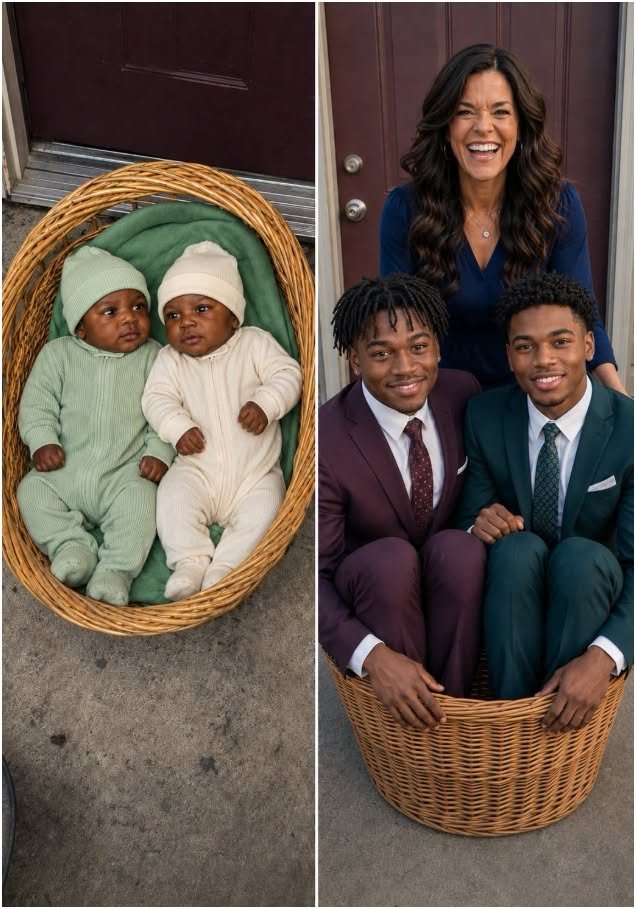
A large wicker basket sat beside my front step.
Inside were two babies.
Two little boys were tucked beneath a soft blanket, curled close to one another.
For a moment, I couldn’t move.
Then one of them made another small sound.
“Oh my God.”
I dropped to my knees.
“Oh my God… oh my God.”
Their faces were pink from the cold.
The blanket around them carried a faint lavender scent.
I dragged the basket carefully inside and reached for the phone.
My hands were shaking so violently that I dropped it once.
Then again.
Finally, I managed to call the police.
“There are babies here,” I told the dispatcher, nearly sobbing. “Someone left two babies on my porch. I don’t know who they belong to. Please send somebody.”
The officers arrived quickly.
One of them, Officer Delaney, stayed with me while another wrapped the babies in warmer blankets.
“Was there a note?” she asked.
“No.”
“Did you see anyone leaving?”
“No.”
“A vehicle?”
I shook my head.
“Nothing. I opened the door, and they were just there.”
Police searched the neighborhood.
They questioned neighbors.
They checked nearby streets.
No one reported seeing anyone carrying babies.
No one remembered an unfamiliar car.
No one came forward.
Eventually, the twins were taken into foster care.
I stood in my living room after they left, surrounded by silence.
I told myself my part in their lives had lasted less than an hour.
I was wrong.
Part 3 — Choosing Them
I couldn’t forget those babies.
I tried.
For days, I told myself they were safe now.
Professionals would take care of them.
Someone would find their mother.
Someone would decide what happened next.
None of that stopped me from remembering the way one tiny hand had wrapped around my thumb.
So I asked whether I could visit.
One visit became another.
Then another.
Soon, I was seeing them every week.
Then twice a week.
I learned their different cries before they even had permanent names.
One was calmer and loved being held.
The other seemed determined to inspect everything around him.
Op een middag, na thuiskomst van een bezoek, stond ik bijna een uur in mijn keuken.
Uiteindelijk heb ik Raymond gebeld.
“Ik wil ze hebben.”
Er viel een stilte.
« Wat? »
“De tweeling. Ik wil ze adopteren.”
Ik begon heen en weer te lopen.
“Ik weet hoe dat klinkt. Ik ben gescheiden. Ik werk vanuit mijn eetkamer. Ik heb nog nooit een kind opgevoed, en nu heb ik het erover om twee baby’s in huis te nemen. Zeg maar dat ik gek ben geworden.”
Raymond antwoordde onmiddellijk.
“Nee, dat heb je niet.”
Ik stopte met lopen.
“Ray…”
“Je houdt van ze.”
Mijn ogen vulden zich met tranen.
“Dat is niet genoeg.”
“Nee. Maar het is wel een beginpunt.”
Ik liet me in een stoel zakken.
“Welke rechter zou naar mij kijken en besluiten dat ik de beste optie ben?”
“De juiste.”
Dat was Raymond.
Hij had een manier om mijn angst te beantwoorden zonder te doen alsof die niet bestond.
Dat weekend kwam hij aan met notitieblokken, mappen, afhaalmaaltijden en meer vastberadenheid dan ik had.
We hebben uren besteed aan het invullen van formulieren.
Op een gegeven moment tikte hij op een gedeelte waarin naar mijn sociaal vangnet werd gevraagd.
« Je gaat jezelf hier onderwaarderen. »
“Ik heb niet veel familie in de buurt.”
“Je hebt mij.”
Ik keek hem aan.
“Raymond, ze vragen naar ondersteuning op de lange termijn.”
“Schrijf mijn naam op.”
“Misschien trouw je ooit. Krijg je kinderen. Verhuis je.”
Hij glimlachte zwakjes.
“Zet me neer, Kim. Oom. Vriend van de familie. Contactpersoon voor noodgevallen. Wat ze ook nodig hebben. Ik blijf.”
Ik schudde mijn hoofd.
“Je hebt je eigen leven nodig.”
Zijn uitdrukking verzachtte.
“Dit is mijn leven.”
Ik dacht dat hij een grapje maakte.
Ik begreep die woorden pas twintig jaar later.
Raymond bracht me naar elke hoorzitting.
Hij heeft de sollicitatiegesprekken afgewacht.
Hij hield mijn hand vast in de gang van het gerechtsgebouw toen mijn been maar bleef trillen.
Vervolgens, maanden nadat er twee onbekende baby’s op mijn veranda waren verschenen, zat ik voor rechter Marsh terwijl ze een stapel documenten doornam.
Ten slotte sloeg ze haar ogen op.
Haar uitdrukking verzachtte.
“Ze zijn van u, mevrouw Kimberley.”
Enkele seconden lang kon ik niet spreken.
“Allebei?”
Ze glimlachte.
« Beide. »
Ik barstte in tranen uit nog voordat ik de kamer uit was.
Ik noemde ze Caleb en Noah.
En ik heb bijna de hele autorit naar huis gehuild.
Dit keer waren het geen tranen om de familie die ik had verloren.
Het waren tranen voor het gezin dat ik had gevonden.
Uitsluitend ter illustratie.
