

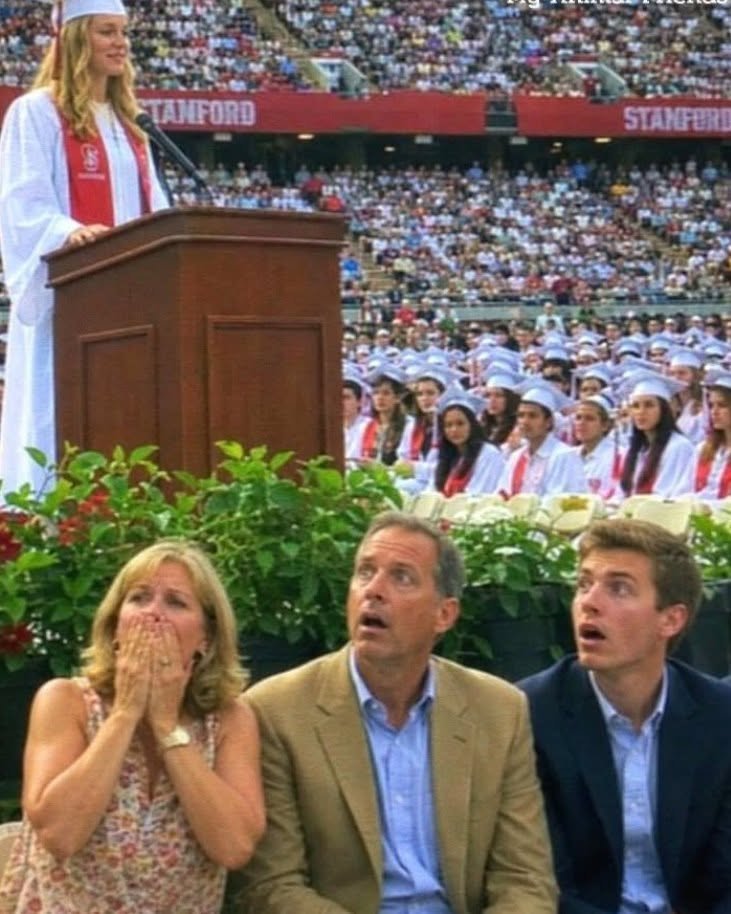
Voor een seconde leek het hele stadion zich te vernauwen rond het gezicht van mijn moeder.
Niet de duizenden afgestudeerden die in hun klapstoelen verschuiven. Niet de felle Stanford-banners die zachtjes wapperen in de Californische bries. Niet het rusteloze gemompel van families die op zoek zijn naar de beste hoek op hun telefoon.
Alleen mijn moeder.
Haar crèmekleurige blazer. Haar pareloorbellen. De glimlach die ze voor Derek had gedragen als een badge.
En toen de manier waarop het verdween.
Ik had dat moment vaker voorgesteld dan ik wilde toegeven.
In de stille uren na lange werkdagen, wanneer de kantoorverlichting bij Solar Reach flikkerde boven lege bureaus en de kar van de conciërge door de gang ratelde, had ik mezelf voorgesteld rechtop te staan terwijl mijn ouders me met spijt aankeken. Ik had me tevredenheid voorgesteld, misschien zelfs triomf. Een schone, filmische sfeer. De dochter die ze over het hoofd zagen werd iemand die onmogelijk te negeren was.
Maar daar staand, met de zon warm op mijn gezicht en een microfoon voor me, voelde ik iets veel ingewikkelders.
Ik zag de mond van mijn moeder een beetje opengaan, alsof ze iets wilde zeggen maar vergeten was hoe. Mijn vader liet zijn telefoon zakken. Derek, die in zijn pet en toga bij de voorste rijen stond, draaide zich halverwege naar Sectie 114 en daarna weer terug naar het podium.
Hij wist het.
Of in elk geval wist hij iets.
Die realisatie kwam harder dan ik had verwacht.
De decaan glimlachte naast me, zich niet bewust van de geschiedenis die zich als een storm onder het oppervlak verzamelde.
« Dr. Mitchell, » zei hij zacht, terwijl hij opzij stapte.
Ik legde mijn aantekeningen op het podium, al had ik ze nauwelijks nodig. Ik had deze toespraak om twee uur ‘s nachts geschreven in een hotelkamer met uitzicht op de campus, dezelfde campus waar ik ooit crackers had gegeten omdat mijn onderzoeksbeurs al op was voordat de huur betaald moest worden. Dezelfde campus waar ik had gehuild in toilethokjes nadat experimenten mislukten. Dezelfde campus waar ik had geleerd dat eenzaamheid zowel een wond als een smidse kon worden.
Ik keek uit over de afgestudeerden.
Zoveel vrolijke gezichten. Zoveel families die trots naar voren leunen.
En ergens tussen hen zat de mijne.
Ik haalde diep adem.
« Goedemorgen, » zei ik.
Mijn stem droeg door het stadion, kalmer en standvastiger dan ik me voelde.
Het publiek reageerde met beleefd applaus.
« Twee jaar geleden, » begon ik, « stond ik op deze campus in een andere mantel, over een ander podium. Ik had net mijn doctoraat afgerond na acht jaar onderzoek naar energiesystemen. Die ochtend heb ik mijn capuchon zelf rechtgezet voor een tweedehands spiegel. »
Er viel een stilte.
Ik keek niet naar mijn moeder. Nog niet.
« Ik was trots, » vervolgde ik. « Ik was uitgeput. Ik was doodsbang. En ik was alleen. »
De woorden bewogen door het publiek als wind door hoog gras.
« Ik heb het grootste deel van mijn volwassen leven gewerkt aan een vraag die eenvoudig klonk: Wat zou er nodig zijn om betrouwbare elektriciteit te brengen naar plekken waar de duisternis nog bepaalt wat mogelijk is? »
I saw a graduate in the front row lift her eyes from her program.
“I did not come from a family of scientists. I did not grow up surrounded by laboratories or investors or people who used words like infrastructure and scalability over dinner. I grew up in a house where achievement mattered very much, but only certain achievements counted.”
My fingers rested lightly on the edge of the podium.
“I learned early that some dreams are easy for others to admire because they come with familiar titles. Lawyer. Banker. Executive. Consultant. And some dreams are harder to explain because they start with failure, uncertainty, and years of work no one can see.”
In Section 114, my father had stopped recording completely.
My mother sat perfectly still.
I could have said more. I could have quoted the text message word for word. I could have watched the entire audience turn to search for the people who had sent it. I could have taken the wound they gave me and placed it in public view.
But the strange thing about standing under that bright sky was that I no longer wanted to bleed for applause.
So I looked back at the graduates.
“Today, many of you are receiving degrees that will open doors. Some of you already know exactly which doors you want. Some of you are pretending you know because everyone keeps asking, and it is easier to smile than to admit uncertainty.”
A ripple of laughter passed through the rows.
“That uncertainty is not failure. It is part of the work. But I want to tell you something that took me too long to learn. Do not measure your future only by who claps at the beginning.”
My throat tightened, but I kept going.
“Some of the most important work you will ever do may be misunderstood by people you love. Some of it may be dismissed. Some of it may require you to keep showing up without approval, without applause, and sometimes without an audience at all.”
I paused.
“Keep showing up anyway.”
The first real applause rose then, warm and unexpected. I waited for it to settle.
“At Solar Reach, our earliest office had eleven chairs and only seven of them were safe to sit on. We had a coffee machine that made noises like a small aircraft, a whiteboard full of impossible deadlines, and enough money in the bank to make everyone nervous.”
Laughter again, louder this time.
“Our first field prototype failed in forty-three minutes. Our second failed before it left the warehouse. At one point, a battery management system caught a software bug that made our lead engineer stare at the ceiling for so long I thought he was praying.”
More laughter.
“But eventually, after months of failure, we watched a village outside Nairobi light up after sunset. I will never forget the sound that followed. It was not cheering, not exactly. It was wonder. Children running toward light. A nurse standing in a clinic doorway with her hand over her mouth. A shopkeeper switching on a sign he had painted three years earlier, waiting for the day he could finally use it.”
The stadium quieted again.
“That was the moment I understood that value is not always recognized by the people closest to you. Sometimes value is proven in the lives changed by what you refused to abandon.”
I turned one page in my notes.
“And that brings me to all of you.”
For the next twelve minutes, I spoke about leadership as service, about ambition without arrogance, about the difference between building something profitable and building something worth being responsible for. I told them not to confuse speed with direction. I told them numbers mattered, but names mattered too. I told them the spreadsheet and the human story had to remain in the same room.
I never mentioned my parents directly.
I never mentioned Derek.
But when I said, “Sometimes the people who doubt you are not villains. Sometimes they are frightened people who only trust roads they have already seen,” my mother lowered her face into her hands.
That was the moment I almost lost my place.
For years, I had imagined her embarrassment as justice. But seeing it did not make me feel powerful. It made me feel tired. It made me remember being six years old at the kitchen table, showing her a drawing of the moon, waiting for her to put it on the refrigerator.
It made me remember wanting less than praise.
Just a place.
I finished my speech with a story I had not planned to tell.
“When I was a little girl,” I said, “there was a storm that knocked out power in our neighborhood for almost two days. I remember sitting in the dark with a flashlight under my chin, trying to make my brother laugh. I remember being afraid every time the wind hit the windows. But I also remember looking across the street and seeing one house with a generator. One glowing window in a row of dark homes.”
I looked toward the horizon beyond the stadium.
“I think part of me has been chasing that window ever since. Not because light solves everything. It doesn’t. But because light gives people a little more time. To study. To heal. To gather. To hope. And sometimes, a little more time changes the entire story.”
I let the silence hold.
“So as you leave here today, I hope you build things that make the world less dark for someone. I hope you have the courage to continue when approval does not arrive on schedule. And I hope, when someone tells you your dream does not matter, you remember that they may simply be standing too far away to see what it can become.”
The applause began before I stepped back.
At first it was polite.
Then it grew.
Rows of graduates stood. Families followed. The sound rolled through the stadium, bright and enormous, until I felt it in my ribs.
I smiled because that was what the moment required.
But my eyes found Derek.
He was clapping too.
Slowly. Carefully. His face unreadable.
Behind him, my father had risen halfway from his seat, as though caught between standing and staying hidden. My mother remained seated, hands folded tightly in her lap.
When I walked offstage, the dean touched my shoulder.
“That was beautiful,” he said. “Truly.”
“Thank you,” I replied.
Backstage smelled of sunscreen, dust, bottled water, and fresh flowers. Volunteers moved around me with headsets and clipboards. Someone handed me a program to sign. Someone else asked for a photo.
I did what was expected.
I smiled. I shook hands. I answered questions about Solar Reach, about financing models, about rural electrification and battery storage, about whether I thought clean energy startups could remain mission-driven after major investment.
All the while, I felt the presence of Section 114 like a hand pressed between my shoulder blades.
I had not come for a confrontation.
I had told myself that all morning.
I had come to speak.
I had come to honor the graduates.
I had come because Stanford asked, because the company mattered, because the work mattered.
And perhaps, if I was honest, because some small unhealed part of me wanted my parents to see me clearly at least once.
After the ceremony ended, I escaped to a quiet hallway beneath the stadium. The concrete walls held the coolness of shade. Above me, the muffled thunder of families reuniting carried through the structure.
I leaned against the wall and closed my eyes.
“Dr. Mitchell?”
Ik heb ze geopend.
Een jonge vrouw in een afstudeerjurk stond een paar meter verderop. Haar kwast zwaaide naast haar wang en haar ogen waren rood alsof ze had gehuild.
« Het spijt me, » zei ze snel. « Ik wil je niet storen. »
« Je stoort me niet. »
Ze slikte. « Mijn ouders zijn ook niet gekomen. »
De woorden kwamen zachtjes in de lucht, maar sloegen krachtig toe.
Ik stapte weg van de muur.
« Ze wilden dat ik de geneeskunde in ging, » vervolgde ze. « Ik koos voor operaties en duurzaamheid. Ze zeiden dat het een fase was. Toen zeiden ze dat ze het druk hadden. Maar eigenlijk waren ze teleurgesteld. »
Haar vingers klemden zich steviger om haar diploma-hoes.
« Toen je zei dat je je toekomst niet moest meten aan wie er aan het begin applaudisseerd… » Ze liet een kleine, beschaamde lach horen. « Dat had ik nodig. »
Even kon ik niet spreken.
Toen zei ik: « Hoe heet je? »
« Priya. »
« Priya, » zei ik, « ik ben trots op je. »
