

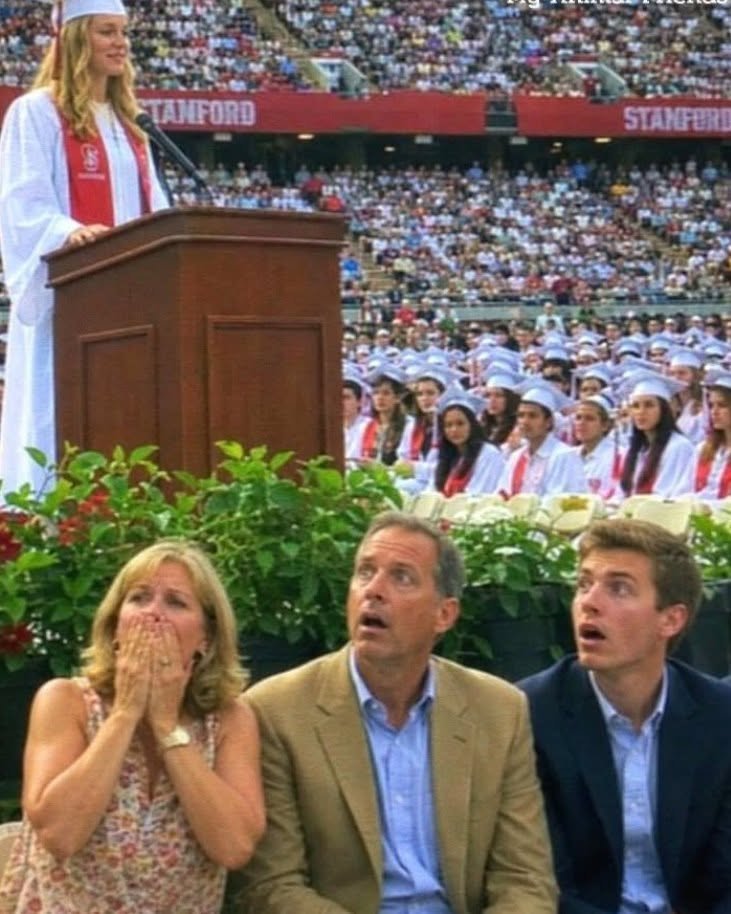
« Ik had dat weekend geen examens, » zei hij.
Het gezicht van mijn moeder verhardde, al was het maar een beetje. Het was een bekende verschuiving. Het moment waarop kwetsbaarheid controle werd.
« Je begrijpt niet hoe het was, » zei ze. « We wisten niet waar Sarah naartoe ging. Acht jaar is een lange tijd. We waren bang dat ze zich op school verstopte omdat ze niet wist hoe ze in de echte wereld moest leven. »
De echte wereld.
Ik moest bijna weer lachen.
« Ik bouwde batterijmodellen en schreef subsidieaanvragen terwijl ik bachelorstudenten lesgaf en vier uur per nacht sliep. »
« Dat wisten we niet. »
« Je hebt het niet gevraagd. »
De woorden vielen zuiver.
Mijn moeder knipperde met mijn ogen.
Voor het eerst leek ze niet beledigd, niet defensief, maar oprecht onzeker.
Mijn vader sprak uiteindelijk.
« We hadden het moeten vragen. »
Ik draaide me naar hem toe.
Hij keek me aan met een droefheid die laat leek, maar niet vals.
« Ik had je moeten bellen, » zei hij. « Meer dan ik deed. Ik zei tegen mezelf dat je het druk had. Ik zei tegen mezelf dat je contact zou opnemen als je ons nodig had. »
« Ik had je nodig, » zei ik.
Zijn gezicht vertrok licht.
Het tafereel deed me wegkijken.
Er zijn momenten waarop woede makkelijker is dan rouw, omdat woede je iets geeft om vast te houden. Rouw opent alleen zijn handen en laat je zien wat ontbreekt.
« Ik moet gaan, » zei ik.
« Sarah, alsjeblieft, » zei mijn moeder. « Kom eten. »
Ik keek haar aan.
« Waarom? »
De vraag leek haar in de war te brengen.
« Omdat we familie zijn. »
Ik wachtte.
Ze keek naar Derek. Toen naar mijn vader. En dan weer naar mij.
« Omdat we moeten praten. »
« Waarover? »
« Alles. »
« Dat is te breed. »
Een vleugje irritatie trok over haar gezicht, maar ze slikte het weg.
« Over je diploma-uitreiking. Over wat er is gebeurd. Over waarom ik zei wat ik zei. »
« En waarom deed je dat? »
De gang leek om ons heen strakker te worden.
Mijn moeder zag er plotseling blootgesteld uit.
« Ik was bang, » zei ze.
I did not answer.
“You were brilliant as a child,” she continued, voice quieter now. “Always asking questions I couldn’t answer. Taking apart radios. Drawing machines. Your teachers said words like gifted, exceptional, advanced. And I was proud. I was.”
I remembered those teachers. I remembered my mother smiling at parent conferences, then growing quiet in the car when they suggested science camps and advanced programs we could not afford.
“But then everything with your uncle happened,” she said.
I froze.
My father’s head snapped toward her.
“Elaine,” he warned.
Derek looked between them. “What about Uncle Paul?”
My mother’s face changed as if she had said something she had not meant to say.
A memory stirred in me.
Uncle Paul had been my mother’s younger brother. In family stories, he was mentioned rarely and vaguely. A genius, people said. A dreamer. Someone who could have been great if he had been more practical. He died when I was nine, though no one ever explained much beyond “an accident” and “a difficult time.”
“What does Uncle Paul have to do with me?” I asked.
My mother pressed her lips together.
“Nothing,” my father said too quickly.
But it was too late.
The air had shifted.
Derek’s brows drew together. “Mom?”
She closed her eyes.
For a moment, I thought she might finally tell the truth.
Instead, she straightened.
“I shouldn’t have brought him up.”
“Too late,” I said.
“Sarah, not here.”
“Then where?”
My mother looked past me toward the reception area, where people in suits and graduation gowns moved beneath strings of red and white balloons.
“Dinner,” she said. “Come to dinner, and I’ll explain.”
I shook my head.
“No.”
“Please.”
“No,” I repeated. “I’m not going to sit through a celebration where everyone pretends this is a normal family moment while you decide how much truth I deserve.”
Her eyes filled at last.
“Then coffee,” she said. “Tomorrow morning. Just you and me.”
The request surprised me.
My father looked surprised too.
Derek watched me carefully.
I wanted to refuse. Every instinct built from years of disappointment told me not to step back into the old room, not to sit across from her and offer another chance to minimize what she had done.
But Uncle Paul’s name had opened something.
A door in a hallway I had thought was sealed.
“What time?” I asked.
My mother exhaled.
“Nine?”
“Seven-thirty,” I said. “I have meetings.”
“Seven-thirty,” she agreed quickly.
“I choose the place.”
“Of course.”
“And if you lie to me, I leave.”
She flinched.
“All right.”
I looked at my father.
“Does this involve you too?”
He hesitated.
“Yes,” he said softly.
“Then you should come.”
My mother turned sharply. “But you said just us.”
“I changed my mind,” I said.
For the first time that day, I saw something like respect pass across Derek’s face.
I left before anyone could say more.
Outside, campus was impossibly beautiful. Families posed beneath palm trees. Graduates threw caps into the air. Bouquets wrapped in cellophane flashed pink and yellow in the sun. Everywhere I looked, people were holding one another.
I walked through it all alone, but it did not feel the same as before.
Two years earlier, loneliness had wrapped around me like proof of being unwanted.
Today, it felt more like space.
Painful space, yes.
But space I owned.
At the reception, I became Dr. Mitchell again. Investors shook my hand. Faculty members asked about partnerships. A dean from the engineering school told me they were developing a new initiative around energy access and wanted Solar Reach involved.
I answered. I smiled. I performed competence with the ease of long practice.
But beneath it all, Uncle Paul’s name kept repeating.
Everything with your uncle.
That evening, back at my hotel, I kicked off my heels and searched through old family records online. Paul Whitaker. My mother’s maiden name. I found almost nothing at first. An old obituary. A local newspaper mention from 2003. A memorial scholarship that no longer appeared active.
Then, buried in a scanned archive from a regional newspaper, I found a headline that made my pulse slow.
← Previous PageLOCAL ENGINEER DIES AFTER STARTUP COLLAPSE
The article was short. Too short for a life.
Paul Whitaker, thirty-four, had been developing low-cost modular power systems for rural communities. His company had failed after a major investor withdrew funding. He had died six weeks later in a car accident outside Portland.
I read the paragraph three times.
Low-cost modular power systems.
Rural communities.
My hands went cold.
I clicked on another article.
This one included a photograph.
A thin man with kind eyes stood beside a workbench, holding what looked like an early prototype of a portable energy unit. Behind him, taped crookedly to the wall, was a child’s drawing.
A moon.
A row of dark houses.
One glowing window.
My breath caught.
I knew that drawing.
Not because I remembered making that exact one, but because I had drawn the same image over and over as a child. The storm. The generator. The glowing window across the street.
Had Uncle Paul seen it?
Had he kept one?
I leaned closer to the screen, heart thudding.
The caption beneath the photo read: Engineer Paul Whitaker pictured in his workshop with a concept sketch by his niece, Sarah Mitchell, age 7.
I sat back slowly.
My hotel room was silent except for the hum of the air conditioner.
For years, I had believed my dream began with a storm and a childhood memory.
Maar misschien had iemand het gezien voordat ik het begreep.
Misschien had iemand het aangemoedigd.
Misschien had iemand naar hetzelfde licht toe gebouwd en verdween uit ons familieverhaal omdat zijn falen hen zo diep bang maakte dat ze probeerden elke vonk die op de zijne leek te begraven.
Mijn telefoon trilde op het nachtkastje.
Een bericht van Derek.
Ik staarde er enkele seconden naar voordat ik hem opende.
Iets gevonden in papa’s koffer. Ik denk niet dat ze weten dat ik het gezien heb.
Toen verscheen er een foto.
Er stond een versleten manillamap, waarvan de randen door de jaren gebogen waren. Aan de overkant van het tabblad, in het handschrift van mijn vader, stonden drie woorden.
PAUL / SARAH / PATENT
Mijn hart begon te bonzen.
Voordat ik een antwoord kon typen, stuurde Derek nog een bericht.
