

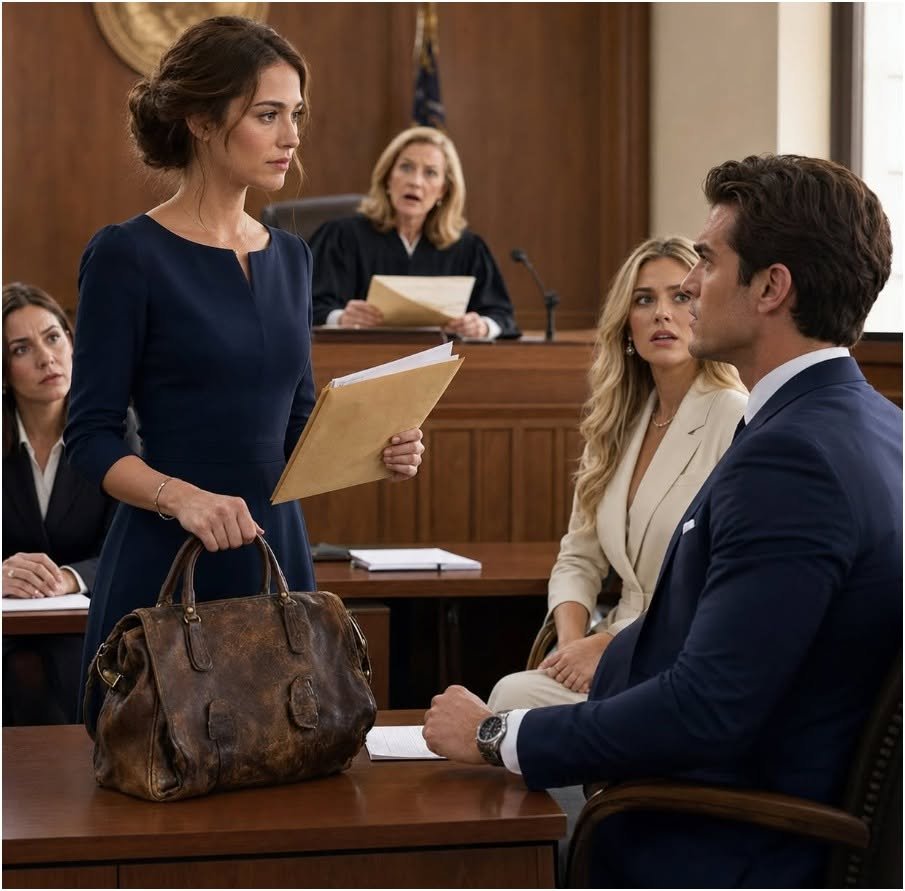
Zes jaar lang betaalde ik voor zijn medische diploma � daarna vroeg hij om een scheiding
Zes jaar lang heb ik zijn medische diploma betaald. De dag dat hij afstudeerde, zei hij dat ik niet langer genoeg voor hem was. Tijdens de echtscheidingszitting heb ik de rechter een envelop gegeven… En toen keek hij naar mijn handtas en barstte in lachen uit.
Dat was het moment waarop ik me niet meer schaamde.
Niet toen zijn advocaat opstond en mijn werk « minimaal » noemde. Niet toen Brandon aan de overkant van de rechtszaal zat in een op maat gemaakt marineblauw pak, alsof hij zijn leven alleen had opgebouwd. Zelfs niet toen hij naar mijn oude bruine handtas keek en die stille lach liet horen, het soort dat een man geeft als hij denkt dat de hele kamer het met hem eens is. Het was een kleine lach, nauwelijks luider dan een hoest, maar ik hoorde het. Dat deed mijn advocaat ook. Dat gold ook voor rechter Elaine Henderson, wiens scherpe grijze ogen net lang genoeg van de documenten opkeken om precies te zien waar Brandon keek.
Mijn handtas lag naast mijn stoel als een getuige.
Het was beschadigd langs de hoeken, het leer was gebarsten bij het handvat, de rits twee keer gerepareerd door een kleine schoenenwinkel aan Jefferson Avenue. Ik had die tas gedragen door diensten in de supermarkt, het afsluiten van diners, kantoorschoonmaakbaantjes, wachtkamers in het ziekenhuis, afspraken met uitleenden en late busritten als mijn voeten te veel pijn deden om de laatste zes blokken naar huis te lopen. Er zaten loonstroken, huurbonnen, ramenpakketten, blarenverbanden, studieboeken die Brandon in de auto was vergeten, en eens een half gesmolten chocoladereep die ik voor hem had gekocht na zijn eerste anatomie-examen omdat hij thuiskwam trillend en zei dat hij niet wist of hij op de medische faculteit hoorde.
He had belonged there because I made sure he could stay.
But in that courtroom, with his new watch catching the fluorescent lights and his new life waiting somewhere outside the courthouse doors, Brandon looked at that old handbag and laughed.
Then the judge opened the envelope.
The courtroom smelled like old wood, printer paper, coffee, and people trying not to panic. The kind of smell every county courthouse seems to have, whether you are fighting over custody, rent, a traffic ticket, or the ending of a marriage you once thought would outlive everything. I sat at the left table with my hands folded in my lap, trying to keep my fingers still. They trembled anyway. Maggie noticed and placed her hand over mine beneath the table.
�You�re okay,� she whispered.
Maggie Alvarez had been my best friend since seventh grade, back when we both wore too much lip gloss and thought passing algebra was the hardest thing life would ask of us. She became an attorney while I became the woman who kept postponing her own future until someone else�s dream finished using her. When Brandon served me divorce papers, Maggie took my case without charging me.
�You�ll pay me someday,� she said, sitting on my bathroom floor beside me after finding me crying so hard I could barely breathe. �Right now, we make sure he doesn�t rewrite your life in front of a judge.�
Across from us, Brandon looked relaxed.
Dr. Brandon Pierce.
That was how his lawyer said his name, with a little pause after the title, as if the word doctor could polish every ugly thing beneath it. His suit fit perfectly. His hair was trimmed by someone who charged more than I used to make on a Saturday double. His shoes were brown Italian leather, the kind he once would have called ridiculous back when we lived in a one-bedroom apartment with peeling paint and a bedroom window we sealed with duct tape every winter.
Back then, he owned two pairs of jeans, three hoodies, and a dream so fragile I wrapped my entire life around it.
Now he sat beside a lawyer named Carter Denham, who spoke as if he had been born in a courtroom and raised by men who billed by the hour.
�Your Honor,� Mr. Denham said, rising with a smooth tug on his jacket, �my client has made an exceptionally generous proposal. Dr. Pierce is prepared to offer Mrs. Morrison a temporary support payment of one thousand dollars per month for two years, along with her personal belongings and her vehicle.�
My vehicle.
A 2015 Honda Civic with a missing hubcap, coffee stains in the passenger seat, and 188,000 miles on the odometer. The same car I drove to three jobs so Brandon could sleep before exams.
Mr. Denham continued, his tone almost bored. �Mrs. Morrison worked various entry-level jobs during the marriage. Cashier work, restaurant service, nighttime cleaning. She made no meaningful professional advancement and contributed minimally to the marital estate while my client pursued an extremely demanding medical education through his own effort.�
Minimally.
The word sat in the air like dust.
I felt Maggie�s hand tighten over mine.
Mr. Denham paced one step, then turned toward the judge. �Dr. Pierce�s current success is the result of his academic excellence, his discipline, and his professional skill. Mrs. Morrison may have offered emotional support, of course, but emotional support is not a substitute for actual financial contribution.�
I looked at Brandon.
He nodded.
A tiny, approving nod.
The same man who once pressed his face into my stomach at our kitchen table and whispered, �I can�t do this without you,� was now nodding while another man told a judge I had barely mattered.
My throat closed.
For a second, I was no longer in family court. I was back in our first apartment, twenty years old, sitting across from Brandon with bills spread between us like a map of every impossible choice. He had just been accepted into medical school. I was halfway through a communications degree at the community college, taking night classes and dreaming of becoming a producer for local radio or maybe working in nonprofit media. I loved words. I loved interviews. I loved the way a story could change depending on who finally got to tell it.
But tuition was due.
Rent was due.
Electricity was overdue.
Brandon�s hands shook as he ran the numbers again and again, as if a different answer might appear if he loved the dream hard enough.
�I don�t know how we make it work,� he said that night. His hair was too long, curling over his forehead. He wore an old gray sweatshirt from a 5K he never actually ran. �Even with loans, I�m short. And once clinical rotations start, I can�t keep picking up shifts at the library.�
I remember looking at him across the table and thinking love was supposed to become practical when it mattered.
�What if I take a year off?� I asked.
His head snapped up. �Grace, no.�
�Just a year.�
�No.�
�Maybe two.�
He stood so fast the chair scraped. �I can�t ask you to give up school.�
�You�re not asking,� I said. �I�m offering.�
He cried then. Not dramatically, not loudly. Just tears he tried to hide with both hands. I walked around the table, wrapped my arms around him, and told him what I believed with every foolish, loyal part of me.
�We�re married. Your dream is our dream.�
That sentence became the first brick in the house I built for him and never got to live in.
I withdrew from school the next week. The registrar asked if I was sure. I said yes because I thought being sure was what love looked like. I took a full-time cashier job at SaveMart and picked up weekend shifts at Mel�s Diner, a place with cracked red booths, weak coffee, and truckers who tipped in quarters but always called me honey. In the beginning, Brandon was grateful. He still folded laundry. He still kissed my roughening hands. He still left sticky notes on the bathroom mirror.
One day I�ll give you everything.
I kept one of those notes in my handbag for years.
By his second year, �a year or two� became a life.
Textbooks cost more than our groceries. His laptop died two weeks before a major exam, and I put a new one on a credit card with an interest rate that should have scared me more than it did. He needed a stethoscope, white coats, exam fees, professional shoes, medical board prep materials, and a car reliable enough to get him to rotations at 4:30 in the morning. I added a nighttime cleaning job at a downtown office building, four evenings a week.
My schedule became mechanical.
SaveMart van zeven naar twee. Bus naar huis. Dertig minuten dutje als de bovenbuurman niet aan het stofzuigen was. Kantoren schoonmaken van vier tot acht. Diner van negen tot sluitingstijd, drie avonden per week. Douche. Slaap. Herhaal. Mijn haar rook naar frituurolie en citroenontsmettingsmiddel. Mijn handen barsten elke winter door bleekwater en bonnetjespapier. Sommige nachten kwam ik zo moe thuis dat ik op de badkamervloer ging zitten om mijn schoenen uit te doen omdat bukken als te veel ambitie voelde.
Brandon studeerde.
En slaagde.
Hij slaagde voor elk examen. Hij maakte indruk op professoren. Hij kreeg onderzoeksmogelijkheden. Hij ging elk jaar rechter staan, alsof de toekomst hem al geschikt maakte voor een betere versie van zichzelf. Ik was trots. God, ik was zo trots dat het bijna pijn deed. Elke keer als hij thuiskwam met goed nieuws, vergat ik even mijn uitputting.
Toen werd zijn wereld wijd.
Zijn klasgenoten kwamen uit families met huizen aan het meer en beleggingsrekeningen. Hun partners hadden carri�res, yogalidmaatschappen, salon-haar en weekendbrunchplannen. Ze droegen kleding die niet uit uitverkooprekken kwam. Ze spraken over reizen, wijn, liefdadigheidsveilingen en netwerken. Ik probeerde gesprekken te volgen als Brandon me uitnodigde, maar meestal was ik te moe om me een persoon te voelen, laat staan een charmante partner.
De eerste keer dat hij zich voor mij schaamde, waren we op een mixer in een balzaal van een hotel in het centrum.
Ik droeg een zwarte jurk die ik tweedehands had gekocht en schoenen die knelden. Mijn nagels waren kort omdat lange nagels door afwashandschoenen heen scheurden. Ik had concealer onder mijn ogen gedaan, maar die kreukelde om negen uur. Brandon stelde me voor aan de verloofde van een klasgenoot, die naar mijn handen keek voordat ze vroeg wat ik had gedaan.
« Ik werk bij SaveMart, » zei ik. « En in een diner. »
« Oh, » antwoordde ze, met een dun glimlachje. « Dat moet wel… aarding. »
Brandon lachte te snel.
Op weg naar huis zei hij: « Je hoeft niet zo specifiek te zijn. »
Als je wilt doorgaan, klik dan op de knop “Volgende” hieronder ⤵
Advertentie
