

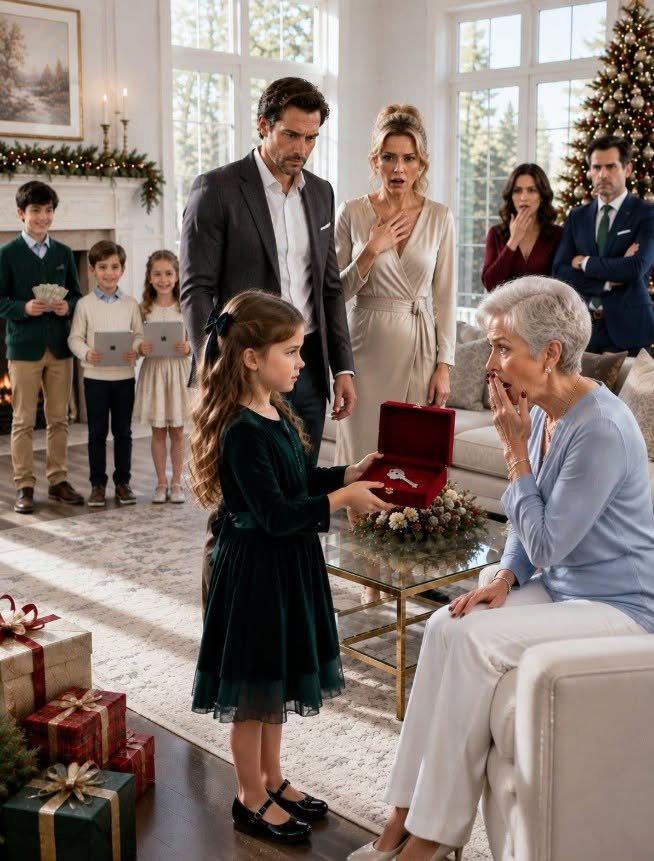
By the time my daughter turned seven years old, she had already learned a painful lesson that no child should ever have to understand.
Sometimes, people do not have to say cruel things directly to make you feel unwanted.
Sometimes, exclusion hides behind polite smiles, carefully chosen words, and small gestures that adults dismiss as meaningless.
But children notice everything.
They notice who gets called by their name.
They notice who receives the biggest gift.
They notice who gets invited to sit at the table and who is quietly reminded that they are only there because someone allowed them to be.
My name is Natalie Mercer, and my daughter’s name is Lila.
When Lila was four years old, I married Grant Mercer.
At that time, I knew marrying someone with a child from a previous relationship would come with challenges. I expected questions, awkward conversations, and moments where we would have to work harder to create a sense of family.
What I never expected was that the hardest person to convince would not be a stranger.
It would be Grant’s own mother.
Lila’s biological father had disappeared from her everyday life long before Grant entered ours. He was not the person who packed her lunch, comforted her after nightmares, or showed up for every school event.
But Grant did.
From the very beginning, he never treated Lila like someone he was “helping raise.”
He never acted like he was doing me a favor.
He simply became her father.
He learned everything about her.
He knew she hated tomatoes but loved strawberries sliced perfectly in half because she said whole strawberries looked “too serious.”
He knew she could not fall asleep unless her stuffed rabbit, Clover, was sitting upright on the small wooden chair beside her bed.
He knew she pretended not to care when she lost a board game but secretly needed a hug afterward.
Most importantly, Grant knew the difference between Lila’s real laugh and the fake little laugh she used whenever she felt uncomfortable.
The real laugh was loud and impossible to control.
The fake laugh was softer.
Shorter.
The kind of laugh a child gives when they are trying to convince everyone around them that they are okay.
And sadly, there was one person who knew that difference almost as well as Grant did.
His mother, Diane Mercer.
The difference was that Grant used that knowledge to protect Lila.
Diane used it to ignore her pain.
Diane was never openly cruel.
That would have been easier.
If she had looked at my daughter and said, “You are not my family,” we could have confronted it immediately.
But Diane was smarter than that.
She knew exactly how to hurt someone while still appearing innocent.
She never said Lila was not family.
Instead, she used small phrases.
Little comments.
Words that sounded harmless when spoken once.
But when repeated for years, they became impossible for a child to misunderstand.
She called her “Natalie’s daughter.”
Sometimes she called her “Grant’s little girl.”
During holidays, she occasionally introduced her as “our little visitor.”
Each individual phrase could be explained away.
That was what made it so difficult.
If I told someone, “My mother-in-law keeps calling my daughter Natalie’s daughter,” they might say, “Maybe she just talks that way.”
If I said, “She calls her a visitor during family gatherings,” someone might respond, “Maybe she means it affectionately.”
But Lila heard the message underneath those words.
You are here.
But you are not really one of us.
For almost three years, Grant and I tried to handle everything quietly.
We did not want unnecessary family drama.
We did not want Lila growing up surrounded by conflict.
We believed that calm conversations could fix things.
Grant spoke to his mother privately several times.
He told her directly that Lila was his daughter.
Not technically.
Not temporarily.
Not conditionally.
His daughter.
Every time, Diane reacted as if we were overreacting.
She would smile, wave her hand dismissively, and say:
“Of course I know that. You two take everything so seriously.”
Then she would hug Lila.
Then, a few weeks later, she would do something else.
Another comment.
Another reminder.
Another moment where my little girl felt like she was standing outside a door that everyone else was allowed to walk through.
That Christmas, we decided to visit Diane’s home outside Bend, Oregon.
It was supposed to be a peaceful family holiday.
At least, that was what I wanted to believe.
The drive there was beautiful.
Snow covered the roads and trees, turning everything into a picture that looked almost too perfect to be real.
Lila sat in the back seat wearing her favorite holiday dress, a deep green one with tiny silver details along the sleeves.
She spent most of the drive talking about Christmas cookies, presents, and whether Clover the rabbit would look better sitting on her bed or near the Christmas tree.
Grant smiled the entire time.
He loved watching her excitement.
Before we walked into Diane’s house, he noticed a small mark on Lila’s black shoe.
He immediately crouched down in the snow-covered driveway and wiped it away with his sleeve.
“There,” he said. “Perfect.”
Lila looked down at her shoes and giggled.
“Dad, they were already perfect.”
Grant smiled and kissed her forehead.
“So are you.”
I stood there watching them for a moment.
That was the kind of father Grant was.
He did not need anyone to tell him Lila was his daughter.
He already knew.
And I remember silently wishing that love would be enough.
I wished that the bond between them would be stronger than the small wounds Diane kept creating.
But as we stepped through Diane’s front door that Christmas, I had no idea Grant had already prepared for the possibility that love alone would not stop someone from hurting our daughter.
He had already made a decision.
A decision that would change everything.
Part 2: The Four-Dollar Candle That Revealed Everything
Christmas morning at Diane’s house looked like something from a holiday movie.
Snow covered the evergreen trees outside the windows.
The smell of cinnamon rolls filled the kitchen.
The fireplace crackled in the corner while nearly twenty relatives gathered around the living room.
Diane loved Christmas.
Not just because of the holiday itself.
She loved the attention.
She loved being the person everyone looked toward.
The organizer.
The host.
The center of the family.
At exactly nine o’clock, she began handing out presents.
And immediately, the difference became obvious.
Her biological grandchildren received gifts wrapped in expensive paper with carefully written names.
Eleven-year-old Carter opened a brand-new tablet.
His younger sister received one as well.
The teenagers were handed envelopes filled with several hundred dollars each.
There were designer headphones, new sneakers, gift cards, winter jackets, and expensive electronics.
Everyone was smiling.
Everyone was excited.
And then there was Lila.
She sat beside Grant on the couch, wearing her green dress and patiently watching everyone else open gifts.
She was not demanding.
She was not complaining.
That was one of the things I loved most about her.
She could find happiness in almost anything.
A pretty leaf.
A smooth rock.
A drawing someone made just for her.
She never measured love by price.
But she noticed when love seemed to have different rules for different people.
After almost everyone had received their gifts, Diane suddenly looked toward Lila.
“Oh!”
She snapped her fingers as if she had just remembered something.
“I almost forgot.”
My stomach tightened.
Diane walked behind the armchair and pulled out a small paper bag.
It had the logo of a local pharmacy printed on the side.
She walked over to Lila with a smile.
“This is for you, sweetheart. I certainly wouldn’t want you feeling left out.”
The words sounded kind.
But something about them felt wrong.
Grant noticed it too.
His expression changed slightly.
Lila did not notice.
She smiled politely and accepted the bag.
“Thank you, Grandma.”
She carefully opened it.
Inside was a small vanilla candle.
A simple candle.
Probably four dollars.
Maybe five at most.
And honestly?
The price did not bother me.
If Diane had given every grandchild a small candle, I would have thought it was thoughtful.
Lila loved simple things.
She would have been thrilled with a handmade ornament or a handwritten card.
The problem was not the gift.
The problem was the message attached to it.
I saw the tag tied around the candle.
A small white paper tag.
Written in Diane’s handwriting.
It said:
“To Grant’s Girl.”
My heart dropped.
The room suddenly felt quieter.
Not completely silent.
But quiet enough that I noticed everything.
A relative stopped opening a gift.
Someone looked down at their coffee.
Another person suddenly became very interested in folding wrapping paper.
They all saw it.
They all understood.
And nobody said anything.
Grant stared at the tag.
His fingers tightened around the paper cup in his hand.
I leaned closer.
“Grant.”
He did not look away from the label.
His voice was low.
“If she does it again, Lila has something for her.”
I frowned.
“What are you talking about?”
Only then did he look at me.
“The red velvet box in Lila’s overnight bag.”
I stared at him.
“You knew this might happen?”
His face was filled with disappointment.
Not anger.
Not surprise.
Disappointment.
“I hoped it wouldn’t.”
He paused.
Then quietly said the words I would remember forever.
“But hoping isn’t the same as protecting her.”
And in that moment, I realized something.
Grant had not been waiting for his mother to change anymore.
He had been waiting for the moment when he needed to choose his daughter over keeping the peace.
