

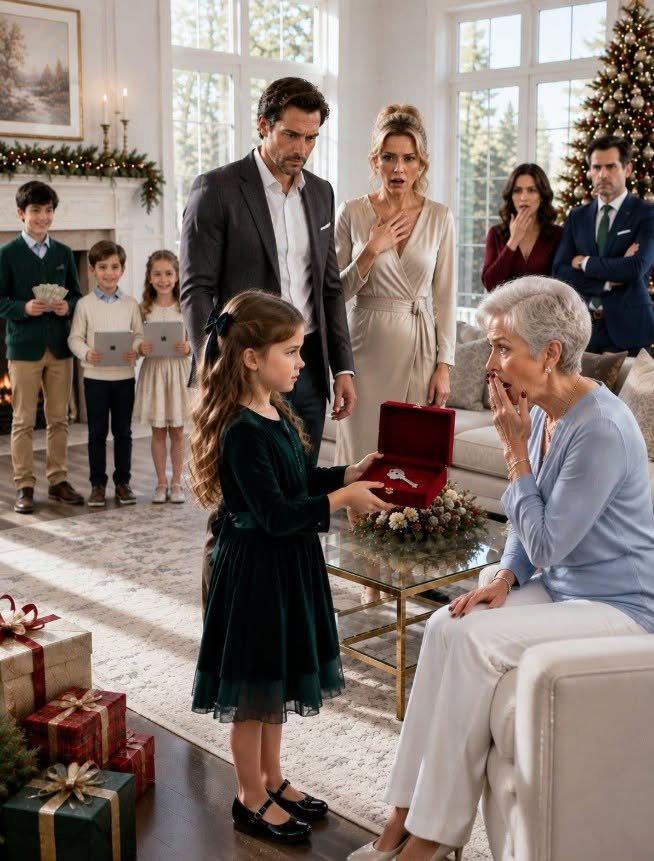
For illustrative purposes only
Part 3: The Question My Daughter Was Too Afraid to Ask
We did not confront Diane that morning.
That was the part that seemed to confuse her the most.
She expected anger.
She expected Grant to raise his voice.
She expected some dramatic argument that would allow her to turn herself into the victim.
But Grant did none of those things.
He simply placed an arm around Lila, thanked Diane for the gift, and continued with Christmas morning as if nothing had happened.
Except something had changed.
Everyone in that room felt it.
The cheerful atmosphere that had existed before was gone.
The laughter sounded more forced.
The conversations felt carefully chosen.
And Diane, who usually enjoyed controlling every moment, seemed unsettled by the fact that Grant was not giving her the reaction she wanted.
The rest of the day continued under a layer of fake happiness.
There were family photos.
There were Christmas movies playing in the background.
There were plates of leftover food passed around the kitchen.
From the outside, it probably looked like a normal family gathering.
But I knew my daughter.
I knew when she was truly happy.
And I knew when she was pretending.
That evening, after most of the relatives had gone to bed, I found Lila sitting alone on the guest-room bed.
The small candle sat beside her.
The tag was still attached.
She was holding the paper between her fingers, carefully tracing the words written on it.
“To Grant’s Girl.”
My heart broke before she even spoke.
“Mom?”
I sat beside her.
“Yeah, sweetheart?”
She hesitated.
Children sometimes pause before asking questions because they are already afraid of the answer.
Lila looked down at her hands.
Then quietly asked:
“Am I only Dad’s girl because I’m not really his daughter?”
For a moment, I could not breathe.
No mother prepares herself to hear their child question whether they belong.
I wanted to immediately tell her that Diane was wrong.
I wanted to tell her that the problem was not her.
That she was loved.
That she was wanted.
But before I could answer, I heard footsteps behind me.
Grant was standing in the doorway.
He had heard everything.
The expression on his face changed instantly.
He walked into the room, closed the door, and knelt in front of Lila.
“Look at me, Lila.”
Slowly, she raised her eyes.
“You are my daughter.”
Her lips pressed together.
“But I’m not your real daughter.”
Grant’s face softened.
He reached forward and took both of her hands.
“Who told you that?”
She shrugged.
“Nobody.”
That answer hurt even more.
Because she was right.
Nobody had said those exact words.
But someone had made her feel them.
Grant took a deep breath.
“Lila, listen to me carefully. Being a father is not about the day someone is born. It is about every day after that.”
He squeezed her hands gently.
“It’s making pancakes with you every Saturday morning. It’s helping you with homework even when you pretend you don’t need help. It’s sitting beside you when you’re sick. It’s learning which stories make you laugh. It’s cheering way too loudly at your school performances.”
A small smile appeared on her face.
“You do cheer too loudly.”
Grant smiled.
“Exactly.”
He brushed a strand of hair away from her face.
“That’s fatherhood.”
For the first time that night, I saw some of the sadness leave her eyes.
Then Grant reached into her overnight bag.
He pulled out something I had never seen before.
A small red velvet box.
He placed it gently in her hands.
Lila looked confused.
“What is it?”
Grant answered softly.
“A boundary.”
She tilted her head.
She was only seven.
She did not understand that word.
He smiled.
“It means nobody gets to keep hurting you just because they are related to us.”
She looked down at the box.
Then back at him.
“Why do I need this?”
Grant glanced toward the candle.
His expression became serious.
“Because sometimes adults ignore things until someone finally shows them that their actions have consequences.”
He explained that the box was not a punishment.
It was not something she had to give Diane.
It was simply a choice.
If Diane made her feel like she did not belong again, Lila could decide whether she wanted to hand it over.
The decision would be hers.
Lila looked nervous.
“Will Grandma be angry?”
Grant did not lie.
“Probably.”
Her eyes filled with worry.
Then she asked the question that nearly destroyed him.
“If she’s angry with me… will you still be my dad?”
Grant immediately pulled her into his arms.
His voice became firm.
“Lila, there is nothing my mother can say, nothing she can do, and nothing she can feel that will ever change the fact that I am your father.”
He held her tighter.
“Nothing.”
I watched my husband comfort my daughter, and in that moment, I understood something.
Grant was not trying to win an argument with his mother.
He was trying to protect a little girl who had already spent too much time wondering if she deserved to be loved.
That night, Lila placed the red velvet box inside her small purse.
And she carried it with her the next morning.
Because Christmas was not over yet.
And Diane still had one more opportunity to show Lila whether she truly belonged.
Part 4: The Place Card That Said Everything Without Saying Anything
The morning after Christmas, Diane hosted her traditional family brunch.
It was one of her favorite traditions.
She believed every detail mattered.
The white dishes had to be perfectly arranged.
The silverware had to be polished.
The napkins had to be folded in a specific way.
And most importantly, every person needed a handwritten place card.
Diane treated the seating arrangement like it was a carefully planned event.
Everyone entered the dining room and found their names.
“Natalie.”
“Grant.”
“Carter.”
“Emily.”
The cards continued around the table.
Cousins.
Aunts.
Uncles.
Grandchildren.
Everyone had a place.
Everyone had a name.
Then I saw Lila’s chair.
At first, I thought maybe Diane had forgotten to write the card.
Then I looked closer.
There was a card sitting above the plate.
But it did not have my daughter’s name.
It said:
“GUEST.”
For a second, I felt like the room stopped moving.
The anger came immediately.
Hot.
Sharp.
Protective.
I wanted to pick up that card.
I wanted to ask Diane how she could look at a seven-year-old child and make her feel like a stranger in her own family.
But before I could move, Grant touched my arm.
He was not looking at Diane.
He was looking at Lila.
Because Lila had already seen it.
She stood completely still.
Her eyes moved from the card.
To Diane.
Then to Grant.
And the heartbreaking part was that she was not crying.
She was not angry.
She was simply waiting.
Waiting to see what her father would do.
Grant said nothing.
I said nothing.
Because this time, we wanted Lila to know something important.
She had a voice.
She had a choice.
Slowly, she reached into her little purse.
Her fingers wrapped around the red velvet box.
The room became quiet.
Several relatives noticed.
Diane noticed too.
And for the first time that entire weekend, Diane looked uncertain.
Lila walked across the dining room.
Each step was small.
But every person at that table felt the weight of it.
She stopped beside Diane.
“Grandma?”
Diane looked up.
“Yes?”
Lila held out the red velvet box.
Her voice was quiet.
“Dad said I could give this to you if you made me feel like I didn’t belong again.”
Everyone looked toward Grant.
He stood up slowly and walked behind his daughter.
Diane gave a nervous laugh.
“Oh, Grant. Really?”
She looked around the table.
“We’re doing this because of a place card?”
Grant’s expression remained calm.
“Open it, Mom.”
Diane stared at him.
For the first time, she realized this was not another conversation she could dismiss.
This was not another warning.
This was a boundary.
And inside that small red velvet box was something that would change their relationship forever.
