

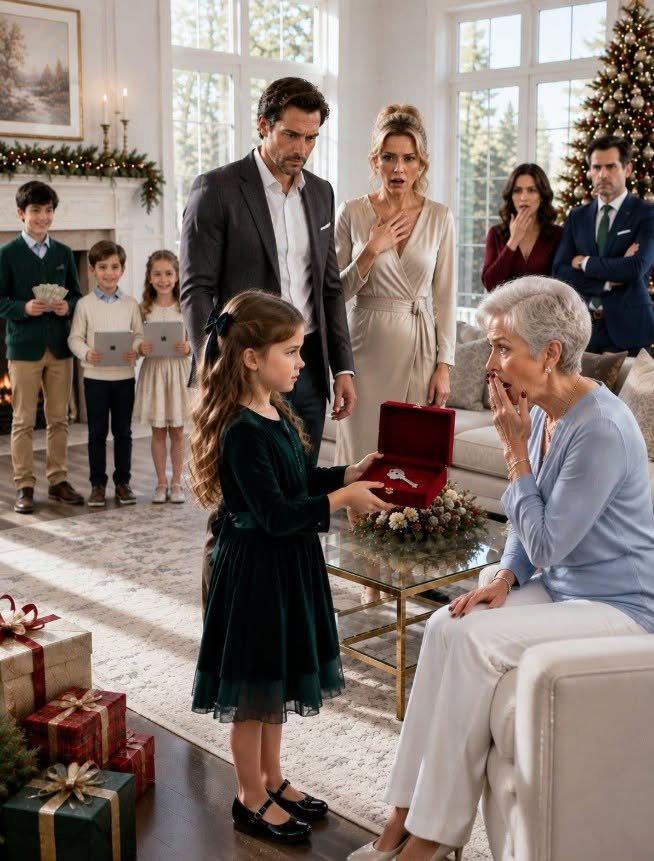
For illustrative purposes only
Part 5: The Key Inside the Red Velvet Box
Diane stared at the red velvet box sitting in her hands.
For several seconds, she did not move.
The confident expression she had carried throughout the entire Christmas weekend slowly disappeared.
Everyone at the table was watching her now.
Not with anger.
Not with judgment.
Just silence.
And sometimes silence reveals more truth than an argument ever could.
Finally, Diane opened the lid.
Inside was a simple brass key.
Nothing expensive.
Nothing dramatic.
Just an ordinary house key.
But the moment Diane saw it, her face changed.
Because she knew exactly what it was.
For years, Diane had kept a spare key to our home in Eugene.
Grant had given it to her long before we were married.
At the time, it seemed like a normal gesture.
A son giving his mother a way to enter if she needed help.
But over the years, Diane had slowly turned that key into something else.
She used it as proof that she believed she had unlimited access to our lives.
She would arrive without calling.
She would walk through the front door without knocking.
And whenever Grant or I expressed discomfort, she would laugh and say:
“A mother shouldn’t need an appointment to visit her son.”
She never understood that our home was not just Grant’s home anymore.
It was our home.
My home.
Lila’s home.
Our family’s home.
Diane picked up the folded paper underneath the key.
Her hands were no longer steady.
She opened the note.
The handwriting belonged to Grant.
The message was short.
But every word carried years of frustration.
He had already changed the locks.
The spare key she had carried for years no longer worked.
She would no longer enter our house whenever she wanted.
She would only enter when she was invited.
And most importantly, if she wanted to rebuild her relationship with our family, it would begin with one simple thing.
She had to accept that Lila was not a guest.
She was not an outsider.
She was not someone who had to earn a place at the table.
She was family.
Diane slowly lowered the note.
Then she looked at her son.
“You changed the locks?”
Grant nodded.
Her voice rose slightly.
“You’re removing your own mother from your home because of her?”
Grant immediately stepped beside Lila.
“No.”
His answer was calm.
Almost too calm.
“I’m changing your access to our home because of you.”
The room went completely silent.
Diane looked stunned.
“She’s seven years old, Grant.”
“Exactly.”
Grant pointed toward the place card still sitting above Lila’s plate.
“She’s seven.”
His voice became firmer.
“You’re an adult. And somehow, you have spent years expecting a seven-year-old child to carry the emotional weight of your choices.”
Nobody spoke.
Diane looked around the table.
She expected someone to defend her.
Someone to say she had not meant anything by it.
Someone to tell Grant he was being too harsh.
But nobody did.
Because everyone there had seen it.
They had seen the separate gifts.
They had seen Lila standing alone in family photographs.
They had seen the little comments and uncomfortable moments.
They had noticed.
They had simply stayed quiet.
Because confronting Diane had always been exhausting.
It was easier to pretend everything was fine.
But now they could see the result of that silence.
A seven-year-old girl had been forced to question whether she belonged.
Part 6: The Family She Chose
Diane stood from her chair.
Her face was filled with hurt and anger.
“So that’s it?”
Her voice trembled.
“You’re choosing Natalie and her daughter over your own family?”
Grant looked at her sadly.
“You still don’t understand.”
He placed one hand gently on Lila’s shoulder.
“Natalie is my wife.”
Then he looked down at his daughter.
“Lila is my daughter.”
He looked back at Diane.
“They are my family.”
Diane shook her head.
“But she isn’t your blood.”
The words landed heavily.
Everyone heard them.
Grant’s expression changed.
Not because he was surprised.
Because he had finally heard her say out loud what she had been implying for years.
“Neither is my wife.”
Diane blinked.
Grant continued.
“Does that mean my marriage isn’t real?”
Nobody moved.
“Family is not a ranking system based on DNA, Mom.”
His voice remained controlled.
“You don’t get to decide that one child deserves a tablet and expensive gifts while another child deserves a cheap candle with a label reminding her that she came from somewhere else.”
Diane opened her mouth.
But Grant continued.
“The candle was never the problem.”
He picked up the small candle from the table.
“If you had given every grandchild a five-dollar candle, nobody would have cared.”
He looked at the tag.
“The problem was the message.”
Then he lifted Lila’s place card.
“And this confirmed it.”
Diane’s eyes filled with frustration.
“You’re humiliating me in my own house.”
Before Grant could answer, Lila spoke.
Her voice was soft.
Almost too soft.
“Grandma?”
Everyone turned toward her.
Diane looked at her.
Lila looked down at her shoes.
“I didn’t want to embarrass you.”
The room became even quieter.
“I just wanted my name on the card.”
Those words hurt more than any argument could have.
Because they were not angry words.
They were the words of a child who did not want revenge.
She only wanted to belong.
Diane had no response.
For once, she had no explanation.
No excuse.
No clever way to make herself the victim.
Because a seven-year-old girl had reduced the entire situation to the truth.
She wanted her name.
Nothing more.
Part 7: The Choice Lila Made
We left Diane’s house shortly after brunch.
There was no screaming.
No dramatic goodbye.
No slammed doors.
Grant simply packed our bags, carried them to the car, and helped Lila put on her coat.
Before getting inside, Lila stopped.
She looked back toward Diane standing in the doorway.
Then she asked:
“Can Grandma still come to our house someday?”
Grant crouched down beside her.
“That is something we will decide together.”
He gently brushed snow from her sleeve.
“When everyone is ready to treat each other with love and respect.”
Lila thought about that.
Then she slowly walked back toward Diane.
“Grandma?”
Diane looked at her.
Lila took a deep breath.
“You can call me when you’re ready.”
Diane looked surprised.
Lila continued.
“But my name is Lila.”
She paused.
“Not Guest.”
Another pause.
“And not Grant’s girl.”
Grant lowered his head for a moment.
I could see how emotional he was.
Because his daughter was not standing up for herself with anger.
She was standing up for herself with dignity.
Then she walked back to us.
During the drive home, Lila fell asleep almost immediately.
Her head rested against the window.
Clover the stuffed rabbit was tucked under her arm.
Grant drove silently for nearly an hour.
Finally, I reached across the console and held his hand.
“How long ago did you change the locks?”
He looked at me.
“Three weeks ago.”
I smiled sadly.
“You really prepared for this.”
Grant looked into the rearview mirror at our sleeping daughter.
“I spent too many years hoping Mom would change because I explained things nicely enough.”
He squeezed my hand.
“Then I realized something.”
“What?”
“Lila shouldn’t have to keep getting hurt while adults wait for another adult to become kinder.”
Part 8: What Happened After Christmas
For almost two months, Diane did not contact us.
At first, she tried to convince relatives that Grant had gone too far.
She told them he had embarrassed her.
She told them he had chosen his wife and stepdaughter over his own mother.
But something unexpected happened.
Nobody rushed to comfort her.
Instead, people finally started telling the truth.
They told her they had noticed.
They had noticed the difference between Lila and the other grandchildren.
They had noticed the gifts.
The photographs.
The comments.
The labels.
They had noticed how Lila became quieter whenever Diane entered the room.
They had just chosen silence because challenging Diane had always been difficult.
But now they understood that silence had allowed the behavior to continue.
In early March, Diane finally called Grant.
She did not ask for her key back.
She did not argue.
She simply asked if she could speak with Lila.
Grant stayed nearby while they talked.
And for the first time, Diane apologized.
It was not a perfect apology.
Real apologies rarely are.
She did not suddenly become a completely different person overnight.
But she did something she had never done before.
She accepted responsibility.
“Lila,” Diane said quietly, “I made you feel like you were visiting a family that was supposed to be yours.”
There was a long pause.
“That was wrong.”
Lila listened.
Then she asked:
“Will you use my name now?”
Diane’s voice cracked.
“Yes, Lila.”
Months later, we invited Diane to our house.
When she arrived, she did not walk straight inside.
She stood at the door.
She waited.
She knocked.
And that small action meant more than she probably realized.
Because the lesson had never only been about a lock.
It had been about respect.
Grant opened the door.
A few seconds later, Lila came running from the kitchen.
Diane smiled nervously.
“Hi, granddaughter.”
Lila looked at Grant.
Then at me.
Then back at Diane.
Finally, she smiled.
“Hi, Grandma.”
The old brass key was never returned.
It did not need to be.
Because access to someone’s life is not automatically guaranteed by a family title.
Love requires respect.
Family requires care.
And sometimes, protecting the people you love means creating boundaries with the people who refuse to see their value.
A child may forget the cost of a Christmas present.
They may forget the wrapping paper.
They may forget the toys.
But they will remember the feeling of standing in a room full of people and wondering why everyone else belongs while they are treated like a visitor.
Grant’s greatest act of fatherhood was not changing a lock.
It was making sure his daughter understood something she should never have had to question.
She did not have to earn her place.
She did not have to prove she deserved love.
She did not have to stay silent to keep peace.
Because when someone tried to make her feel like she was standing outside the family circle, her parents stood beside her and reminded her of the truth.
The only truth that ever mattered.
“You belong with us.”
