

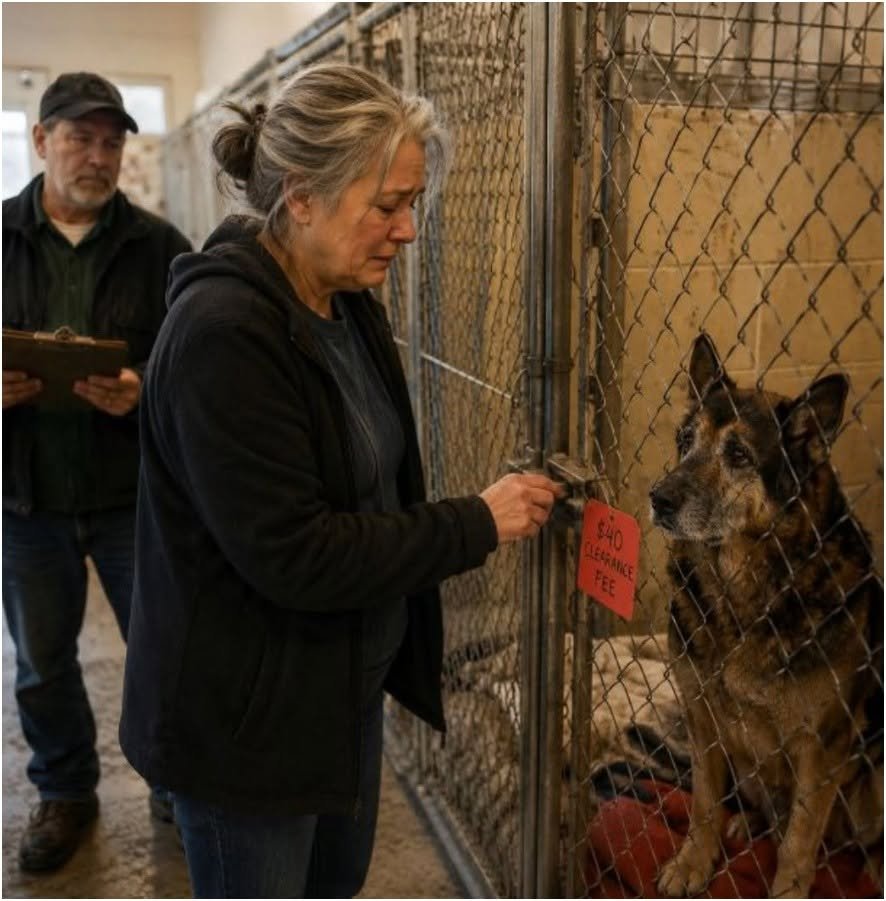
Ze plakten een toegangslabel op een oude K9—toen redde hij een vergeten vrouw
« Mevrouw, ik vertel u dit voor uw eigen bestwil. Die hond is geen huisdier. »
De asielmanager stond tussen mij en de deur van de kennel met beide handen om een klembord geklemd, alsof papier een vrouw kon tegenhouden die die week al alles had verloren.
Achter de tralies blafte de oude Duitse Herder niet.
Hij zat volkomen stil.
Te stil.
Zijn oren stonden hoog, zijn ogen waren moe, en zijn grijze snuit leek bestrooid met as.
Een rood label hing aan het slot.
LAATSTE BEOORDELING.
Daaronder had iemand met zwarte stift geschreven:
$35 ADOPTIEGELD.
Vijfendertig dollar.
Dat was wat ze hadden besloten dat hij waard was.
Ik keek naar het kaartje dat met kabelbinders aan de gaasdeur was bevestigd.
Naam: ORRICK
Leeftijd: 11
Gepensioneerd K9 Zoekhond
Artritis
Gehoorverlies Schrikreactie
Alleen thuis ervaren
« Zijn dossier zegt dat hij vermiste mensen heeft gevonden, » zei ik.
De opvangmanager, Sable Quince, keek naar beneden.
« Dat deed hij. »
« Kinderen? »
Her mouth tightened.
“Three that I know of.”
“Elderly people?”
“Yes.”
“Then why is he back here like old furniture nobody wants?”
Sable closed her eyes for one second.
When she opened them, they were wet but hard.
“Because people clap for heroes when they’re useful, Mrs. Wrenlow. They rarely show up when the hero needs help standing.”
My hand went to the cold metal latch.
Orrick’s amber eyes stayed on me.
Not begging.
Not performing.
Just waiting.
Three days earlier, a young man with shiny shoes and a soft voice had walked me into a small conference room at the corporation where I had worked for thirty-two years.
He offered me bottled water before he erased my life.
“Maribelle,” he said, like we were friends, though I was old enough to have packed his school lunches, “your position has been eliminated as part of a restructuring effort.”
Restructuring.
That is such a clean word for a dirty thing.
It sounds like moving furniture.
It does not sound like taking a woman’s paycheck, routine, dignity, and health insurance, then handing her a cardboard box with her coffee mug in it.
I had given that place my knees, my eyes, my evenings, my patience, my holidays, and the softest years of my only child’s life.
I had missed school concerts because shipments were late.
I had eaten crackers at my desk while younger managers used words like “family” and “team.”
I had trained five people who got promoted over me.
And when they were finished with me, they called it a transition.
I drove home with my cardboard box belted into the passenger seat like a dead body.
My house sat on Briar Hollow Road, a long, low ranch with a porch my husband, Ellery, had built before his hands got stiff.
He had been gone seven years.
Our son, Tavian, called that evening from three states away.
He tried to be gentle. That almost made it worse.
“Mom, maybe this is a sign,” he said.
“A sign of what?”
“That it’s time to simplify.”
Aanmelden op Tatticle!
Ontvang in uw inbox updates over de laatste berichten en meer van Tatticle.
Website
Jouw e-mail…
Aanmelden
We gebruiken je persoonsgegevens voor op interesses gebaseerde advertenties, zoals beschreven in onze privacyverklaring.
I stared at the kitchen wall where Ellery had once measured Tavian’s height in pencil marks.
“Simplify,” I repeated.
“You know what I mean. The house is a lot. The yard is a lot. You’re alone there. Maybe you could sell and move closer to me.”
There it was.
The word alone.
People say it like a diagnosis.
As if a woman over sixty in a quiet house is automatically a problem waiting to happen.
“I am not helpless,” I said.
“I didn’t say you were.”
“You didn’t have to.”
He sighed.
I could hear traffic in the background, the life he had built far away from mine.
“I just worry about you.”
“I know.”
But worry can become a leash, even when it is made of love.
After we hung up, I sat at my kitchen table until the room got dark around me.
No work emails.
No meeting reminders.
No one asking where the missing invoice went.
No one needing me.
The silence pressed against my ears until I stood up, grabbed my keys, and drove without knowing where I was going.
That was how I ended up at the county animal shelter during a discount adoption weekend.
The front kennels were full of noise and hope.
Puppies jumped against doors.
Small fluffy dogs spun in circles.
A young couple argued over which one would look better in pictures.
Children pointed and squealed.
Everyone wanted something young.
Something easy.
Something that had not yet cost too much.
I kept walking.
Past the cute ones.
Past the clean cards with smiling photos.
Past the row where families stood in clusters, imagining happy endings they could control.
At the very back, the air changed.
It smelled sharper there.
Bleach.
Old blankets.
Fear.
This was the row people visited when they wanted to feel kind but not commit.
And in the last kennel sat Orrick.
Massive shoulders.
Cloudy eyes.
One torn ear.
A scar across the bridge of his nose.
His back legs trembled when he shifted his weight, but he corrected himself quickly, as if ashamed of the weakness.
I knew that feeling.
I had done the same thing in the conference room.
Kept my chin up.
Kept my voice steady.
Walked out before they could see me shake.
“His handler couldn’t keep him?” I asked Sable.
She made a tired sound in her throat.
“Long story. The short version is, Orrick gave his body to the job. Then his body became inconvenient.”
I looked at the old dog.
“Orrick,” I said softly.
His ears moved.
Just a little.
Like a rusted door opening.
Sable stepped closer.
“I have to be clear. He paces at night. He hates sudden noise. He does not like being grabbed. He may never cuddle. He may never play fetch in your yard like a normal dog.”
I almost laughed.
Normal.
I had spent the last three days trying to remember what that word meant.
“I don’t need normal,” I said.
Sable searched my face.
“You live alone?”
“Yes.”
“Family nearby?”
“No.”
“Any experience with working dogs?”
“No.”
“Then why him?”
The question hit a place in me that was still bleeding.
Because he looked like a soul that had done everything asked of him and still ended up unwanted.
Because I knew what it felt like to have a file summarize your whole life in cold words.
Because if I walked away from that kennel, I would never stop seeing his eyes.
“Because nobody should spend their last chapter behind bars with a clearance tag on the door,” I said.
Sable looked at me for a long moment.
Then she unlocked the kennel.
Orrick did not rush out.
He stood slowly, joints stiff, paws careful on the concrete.
Up close, he was larger than I expected.
His head came almost to my waist.
He smelled like shelter soap and old pain.
Sable clipped a leash to his collar.
“Easy,” she said.
Orrick glanced at her.
Not as a pet looks at a person.
As a soldier looks at an order.
Then he looked at me.
I held my breath and reached out my hand.
He sniffed my fingers.
His nose was dry and warm.
Then he turned away, as if the matter had been decided.
That was how I brought home an eleven-year-old retired K9 three days after becoming an unemployed sixty-one-year-old woman with no plan.
Orrick rode in the back seat of my old SUV sitting upright.
He did not look out the window like happy dogs do.
He scanned the road.
Driveways.
Trees.
Mailboxes.
Every passing car.
When I turned into my driveway, he stiffened.
“You’re safe,” I said.
He did not believe me.
I did not blame him.
The first night was awful.
He walked the whole house again and again, nails clicking on the hardwood.
Kitchen.
Hall.
Bedroom door.
Front window.
Back door.
Repeat.
I put a soft bed in the living room. He ignored it and slept sitting up by the front door.
At two in the morning, I found him staring at the coat closet, growling so low I felt it in my ribs.
“It’s just coats,” I whispered.
He did not look away.
I opened the door to show him.
My husband’s old work jacket hung inside.
I had not touched it in seven years.
Orrick sniffed the cuff.
Then he backed away and sat down.
I sat on the floor beside him, my knees complaining.
“That belonged to Ellery,” I said.
Orrick stared at me.
“My husband.”
The word husband still felt like reaching for a railing that was no longer there.
“He used to leave peppermint candies in the pockets. Said life was hard enough without bitter breath.”
I smiled, then cried so suddenly it startled me.
Orrick’s ears went back.
He did not come closer.
But he did not leave.
That was the beginning of us.
Not love.
Not yet.
Just two wounded creatures sharing the same hallway because neither of us could sleep.
The next morning, I found three rejection emails from jobs I did not even want.
Thank you for your interest.
We have chosen to move forward with candidates whose experience better aligns with our current direction.
There it was again.
Direction.
Companies loved that word.
They were always going in another direction, and somehow that direction never included women like me.
I read the emails out loud to Orrick.
He lay under the kitchen table with his chin on his paws.
“What do you think?” I asked.
His cloudy eyes blinked.
“You’re right. Cowards.”
For the first time in three days, I laughed.
It came out cracked and ugly, but it was real.
Orrick lifted his head.
Maybe laughter sounded like danger to him.
Maybe joy did.
Over the next weeks, we built a life out of awkward pieces.
I learned he would eat only if I stood nearby.
He learned the washing machine was not an enemy.
I learned not to approach him from behind.
He learned the mail carrier was allowed to exist.
I bought him a plush duck.
He inspected it like evidence, sneezed on it, and never touched it again.
I bought him an orthopedic bed.
He circled it for ten minutes before lying beside it on the floor.
I tried to put my arms around his neck once.
He froze so completely I pulled back, ashamed.
“Sorry,” I whispered.
He turned his head away, not angry.
Just confused.
Affection was not a language he had been trained to understand.
Neither was rest.
I understood that too.
For thirty-two years, I had measured my worth by what I finished before lunch.
Now, at nine in the morning, I would stand in my kitchen holding a cup of coffee with nowhere to be, feeling like a ghost in my own house.
So I gave Orrick a job.
It started small.
“Perimeter check,” I said one morning, feeling foolish.
His head snapped up.
I opened the back door.
He stepped outside slowly, nose working.
He walked the fence line, stiff but focused.
When he came back, I said, “Good work.”
His tail moved once.
Barely.
But I saw it.
After that, every morning, we checked the yard.
Then the mailbox.
Then the porch.
He waited for the words.
I needed them too.
Work.
Purpose.
A reason to stand up straight.
Our neighbor, Liora Fenwick, watched us from across the road.
She was seventy-four, thin as a fence post, with silver hair she wore in one long braid down her back.
She walked with a cane but carried herself like she might use it as a weapon if needed.
One morning she called from her porch, “That dog looks like he knows where every body is buried.”
I stopped.
Orrick looked at her.
“He’s retired,” I said.
Liora snorted.
“Nothing with eyes like that is retired.”
I should have been offended.
Instead, I crossed the road.
Liora looked Orrick over without reaching for him.
Smart woman.
“What’s his name?”
“Orrick.”
Her face changed.
Just a flicker.
“You don’t mean county K9 Orrick?”
“You know him?”
“Everybody over sixty with a memory knows him.”
She leaned on her cane.
“He found little Brexley Vale after she wandered from a picnic. Found a man named Orson Pike when his sugar dropped on the old rail trail. Found two teenagers after their canoe turned over below Miller’s Bend.”
Orrick stood still while she spoke.
But his ears moved at the names.
Liora’s voice softened.
“He was something in his day.”
I felt heat rise in my chest.
“He’s something now.”
She looked at me then.
Really looked.
Not at my gray roots.
Not at my old sweatshirt.
Not at the woman the corporation had discarded.
At me.
“Yes,” she said. “I suspect he is.”
A few days later, a man named Nollis Creed stopped me outside the local feed store.
He was tall, stooped, and wore a faded cap with no logo on it.
His face had deep lines, like someone had carved worry into him with a dull knife.
“That Orrick?” he asked.
The dog stood beside me, alert.
“Yes.”
Nollis swallowed hard.
“I was a deputy years ago. Worked a few scenes with him.”
He crouched slowly, but did not touch.
“Hello, old man.”
Orrick stared.
Then his tail gave one heavy thump.
Nollis pressed his lips together.
“I wondered where he ended up.”
“At the shelter,” I said. “Back row. Thirty-five dollars.”
The man’s face collapsed inward.
“Lord.”
“You all called him a hero.”
“We did.”
“Then you left him there?”
His eyes filled.
“I’m not proud of it.”
I wanted to stay angry.
It would have been easier.
But shame stood in front of me wearing an old cap and tired eyes.
Nollis looked toward the parking lot.
“People think institutions take care of things. Dogs. Men. Women. Old promises. But institutions are just buildings full of people waiting for somebody else to do the decent thing.”
That stayed with me.
I thought about it while paying bills.
While brushing Orrick.
While circling job postings that asked for thirty years of experience and the energy of a twenty-five-year-old.
Somebody else.
That was the lie that let good things rot.
Tavian visited the following month.
He arrived with two overnight bags, a strained smile, and the kind of worry that starts organizing your kitchen without asking.
He hugged me too tightly.
“You look thinner,” he said.
“I look like myself.”
He glanced at Orrick, who was sitting near the hallway, watching.
“That dog is huge.”
“He’s old.”
“That doesn’t make him small.”
“Tavian.”
“What? I’m just saying.”
Orrick’s eyes followed him.
Tavian lowered his voice.
“Mom, this is a lot.”
“What is?”
“The dog. The house. The job situation. All of it.”
There it was again.
Situation.
A word people use when your life makes them uncomfortable.
“I’m handling it.”
“I know you think you are.”
That one went into me clean.
I stood at the sink, hands wet from rinsing a coffee cup.
“You know I think I am?”
He rubbed his forehead.
“I didn’t mean it like that.”
“Yes, you did.”
Orrick rose slowly.
Not growling.
Not threatening.
Just standing.
Tavian noticed.
“See? That. That’s what I’m talking about.”
“He’s responding to my voice.”
“He’s unpredictable.”
“So am I, apparently.”
“Mom.”
“No, Tavian. Say what you came to say.”
He looked miserable.
“I think you should consider selling the house before things get harder. Move near me. Get a smaller place. No stairs. No yard. No dangerous dog.”
I laughed once.
It had no humor in it.
“You put my whole life in four little boxes. Smaller place. No stairs. No yard. No dog.”
“I’m trying to protect you.”
“From what? Making choices?”
“From getting hurt.”
“I am already hurt.”
He went quiet.
I turned away because I did not want him to see my face.
“I lost my husband. I lost my work. I lost the version of myself people knew how to talk to. Do not stand in my kitchen and tell me the answer is to lose my home too.”
Tavian’s shoulders dropped.
For one second, he looked like the boy who used to crawl into bed after nightmares.
Then Orrick gave a sharp bark.
A package had hit the porch.
Tavian jumped.
Orrick moved toward the door, stiff and focused.
“Enough,” Tavian said. “That bark alone could scare a child.”
“He is not a monster.”
“I didn’t say monster.”
“You didn’t have to.”
The next day, the argument followed us to the community picnic at the little park near the old schoolhouse.
I should not have brought Orrick.
I know that now.
But part of me wanted people to see him standing beside me.
Part of me wanted proof that we could still belong somewhere.
For an hour, it went fine.
Orrick lay under a tree near my chair. Children stared from a distance. Liora sat beside me, eating pie from a paper plate and pretending not to watch everything.
Then a metal chair fell over behind us.
The sound cracked through the air.
Orrick lunged up, barking hard.
Not biting.
Not chasing.
But loud enough to freeze every head in the park.
A woman grabbed her little boy and pulled him behind her.
Someone muttered, “That dog shouldn’t be here.”
Tavian’s face went pale.
Orrick shook, confused, eyes wide, searching for a threat no one else could see.
I put myself between him and the crowd.
“Orrick,” I said. “Stand down.”
His breathing was rough.
“Orrick. With me.”
He looked at me.
For a terrible second, I was not sure he knew where he was.
Then he lowered his head.
A woman near the food table said, “If that thing bites someone, don’t say nobody warned you.”
I took Orrick home before my tears could shame me in public.
That evening, Sable called.
“There was a complaint,” she said.
“I know.”
“I told them he did not attack anyone.”
“But?”
“But if there’s another formal report, they may ask for a review.”
I sat on the edge of my bed.
Orrick lay in the doorway, exhausted.
“A review,” I said.
“I’m sorry.”
I looked at the old dog’s swollen hips.
He had given his whole life to finding lost people.
Now one frightened bark might be enough to erase him again.
Tavian stood in the hall.
He had heard enough.
“Mom,” he said gently, “maybe this is the sign.”
I looked up.
“No.”
“You can’t fight everyone.”
“I’m not trying to fight everyone.”
“Then what are you doing?”
I looked at Orrick.
He looked back at me.
“I am trying not to abandon something just because it became difficult.”
Tavian flinched.
Good.
Some truths should bruise a little.
He left the next morning.
Before he did, he hugged me at the door.
“I love you,” he said.
“I know.”
“I just don’t want to lose you.”
“You won’t keep me by shrinking my life until it fits your fear.”
His eyes filled, but he nodded.
After he drove away, the house felt bigger.
But not empty.
Orrick leaned against my leg.
It was the first time he had chosen touch.
I put my hand on his head.
Carefully.
He stayed.
That was enough.
Late that summer, Willa Rue Bellamy began leaving drawings in my mailbox.
She lived down the road in a yellow house with a sagging porch and too many flowerpots.
She was eight, small for her age, with serious eyes and uneven braids.
The first drawing showed Orrick with a crown.
Under it, she had written:
OLD DOG KING.
I taped it to the refrigerator.
The next day, she left another.
This one showed Orrick with wings.
SEARCH ANGEL.
I found her standing by the mailbox two mornings later, clutching a purple crayon.
“Does he bite?” she asked.
“No.”
“Does he like children?”
“He likes respectful people.”
She considered that.
“I can be respectful.”
“I believe you.”
Orrick stood behind my leg, watching her.
Willa Rue did not squeal or run at him.
She simply sat on the grass on the other side of the fence and opened a book about fossils.
Then she read aloud in a soft, careful voice.
Orrick listened.
Or maybe he just liked the quiet.
Either way, he lay down.
After that, Willa Rue came most afternoons.
She read facts about old bones, lost ships, birds, and planets.
Orrick never licked her face.
He never chased a ball.
He never became the kind of dog people put in cheerful greeting cards.
But he lay near the fence while a lonely child read to him.
Sometimes, that is the holiest kind of healing.
Around that time, Liora told me about Calista Morn.
“You should check on her,” she said one morning.
“Who?”
“Calista. Lives past the bend, beyond the rail trail.”
“I don’t know her.”
“Most people don’t anymore.”
The way she said it made my stomach tighten.
Calista Morn was eighty-two, widowed, and proud enough to turn help into an insult.
She had once made quilts for half the county, Liora said.
She used to volunteer at the library, bring casseroles to funerals, and remember every child’s birthday.
Then her husband died.
Then her hips went bad.
Then invitations slowed.
Then people got used to not seeing her.
That was the part that chilled me.
People got used to not seeing her.
Disappearing does not happen all at once.
It happens when one missed Sunday becomes two.
When people stop asking because asking feels awkward.
When your name becomes “I wonder whatever happened to…”
I did not want to go.
That is the truth.
I was afraid Calista would be rude.
I was more afraid she would be a mirror.
Still, I baked a loaf of lemon bread and drove to her little house at the end of Briar Hollow Road.
Orrick came with me.
Calista’s yard was overgrown, but not filthy.
There is a difference between neglect and a battle being slowly lost.
I knocked.
After a long time, the door opened three inches.
One pale blue eye looked out.
“I’m not buying anything.”
“I’m Maribelle Wrenlow. I live down the road.”
“I know where you live.”
That startled me.
“I brought bread.”
“I have bread.”
“Not this bread.”
The eye narrowed.
“I don’t need charity.”
“Good. I don’t have any to spare.”
That got me half an inch more door.
Then Orrick shifted beside me.
Calista looked down.
Her face changed so completely I almost stepped back.
“Orrick,” she whispered.

