

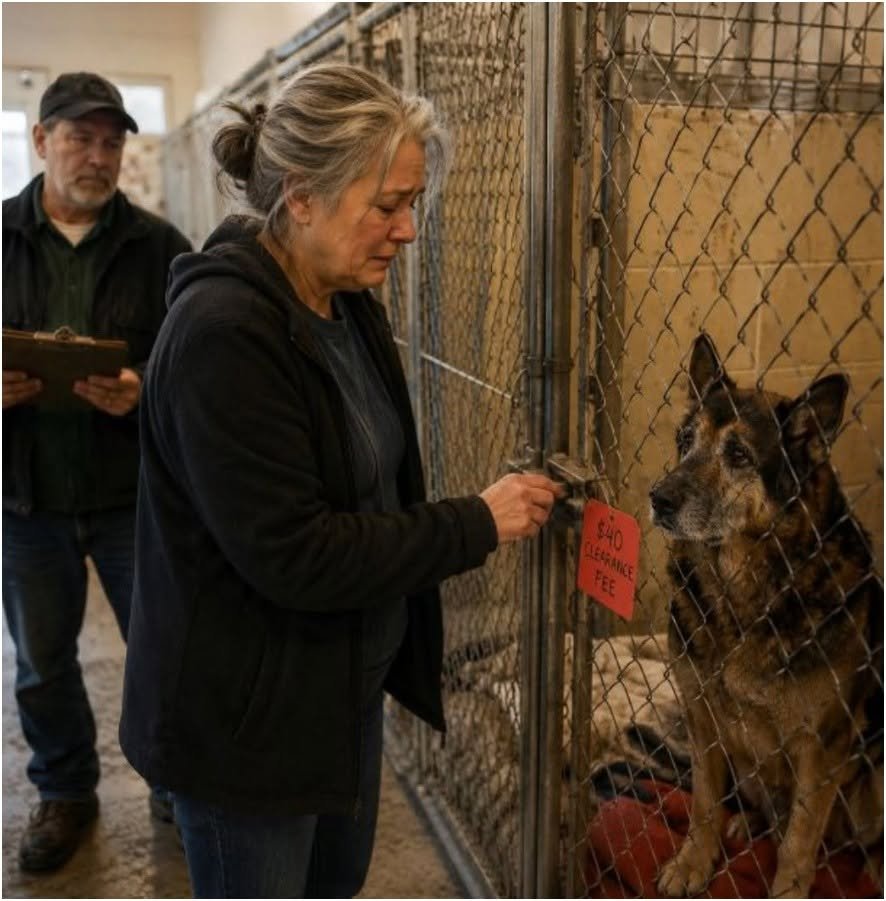
The dog’s ears lifted.
Not fully.
Just enough.
“You know him?”
Calista opened the door wider.
Her hair was white and thin, pinned badly at the back.
Her dress hung loose on her shoulders.
But her eyes were fierce.
“He found my Iven,” she said.
I waited.
“My husband. Years ago. He fell off the deer path and broke his ankle. Cold night. Nobody could hear him.” Her hand tightened on the door. “That dog found him before morning.”
Orrick looked at her, quiet as stone.
Calista swallowed.
“Iven always said Orrick had more sense than most men in boots.”
I smiled.
“He still does.”
She looked at the lemon bread.
Then at me.
Then back at Orrick.
“You can put it on the counter,” she said.
That was as close to an invitation as Calista Morn offered.
Her house smelled like dust, lavender soap, and old wood.
There were quilts folded on chairs.
Photographs on every wall.
A man with laughing eyes.
A younger Calista holding a blue ribbon.
A baby.
A boy.
A family that time had carried away in pieces.
She did not ask me to sit.
I did anyway.
That made her snort.
“You always this pushy?”
“Lately.”
“Good. World needs more women who don’t wait for permission.”
I liked her then.
Not because she was sweet.
Because she was not.
Sweetness is lovely, but it is not always honest.
Calista was all sharp edges and hidden bruises.
Over the next weeks, I stopped by every few days.
She complained each time.
Then she kept the coffee ready.
Orrick always walked the edge of her property.
He seemed restless there.
Especially near the overgrown trail behind her shed.
He would stand facing the trees, nose lifted, body tense.
“Old rail trail,” Calista said once. “Used to lead to the creek bridge. It’s half washed out now. No reason to go back there.”
Orrick disagreed.
I could see it in him.
Some memory lived in that ground.
One evening, Willa Rue came by with a drawing for Calista.
She had drawn Orrick standing beside an old woman with a crown.
Calista looked at it for a long time.
“My nose is not that big,” she said.
Willa Rue froze.
Then Calista added, “But the crown suits me.”
The child grinned.
That was how our strange little circle formed.
A discarded woman.
A retired dog.
A nosy neighbor.
A forgotten widow.
A serious child with purple crayons.
It was not the life I had lost.
It was not the life I had planned.
But slowly, without asking permission, it became a life.
Then came the night that changed everything.
It was close to dinner when Orrick began pacing.
Not his usual stiff wandering.
This was different.
His head was low.
His nose worked the air.
He went to the front door, then the back, then the front again.
“Orrick?”
He whined.
I had heard him bark, growl, groan, and sigh.
I had never heard him make that sound.
I looked out the kitchen window.
Across the fields, Calista’s porch light was off.
It was always on by then.
Always.
A small yellow square at the end of the road.
I called her.
No answer.
I called again.
No answer.
I told myself old women nap.
I told myself bulbs burn out.
I told myself not to become dramatic.
Orrick barked once.
Sharp.
Commanding.
My skin went cold.
I called Liora.
“Calista’s porch light is off,” I said.
Silence.
Then Liora said, “Go.”
“I should call for help first.”
“Do both. But go.”
I called the local emergency line and told them I was checking on an elderly neighbor who might be in trouble.
Then I grabbed Orrick’s leash.
He nearly pulled me off the porch.
Not fast.
His body could not do fast anymore.
But every inch of him pointed toward Calista’s house.
We reached her porch, and I pounded on the door.
“Calista!”
Nothing.
The door was locked.
Orrick was not looking at the door.
He was looking toward the shed.
Toward the old rail trail.
“No,” I whispered.
He pulled.
His hips shook, but he pulled.
I followed.
Branches scraped my arms.
The trail was narrow and choked with weeds.
My knees hurt.
My breath burned.
Orrick moved ahead, limping with terrible purpose.
Twice, he stumbled.
Twice, he got back up before I could help him.
“Orrick, slow down.”
He ignored me.
For the first time since I had adopted him, I saw the dog he had been.
Not young.
Not whole.
But certain.
Completely certain.
The trail dipped near the creek.
I heard water before I saw it.
Then Orrick stopped so suddenly I nearly stepped on him.
He dropped to his belly at the edge of a washed-out slope.
His whole body trembled.
I looked down.
At first, I saw only roots and mud.
Then a pale hand.
“Calista!”
She lay half-hidden below the trail, caught against a fallen branch.
Her face was turned sideways.
Her eyes were closed.
One shoe was gone.
I do not remember climbing down.
I remember mud under my palms.
I remember my heart slamming so hard I felt sick.
I remember Orrick sliding beside me, claws digging, old joints screaming in every movement.
Calista was breathing.
Shallow.
But breathing.
“Calista, it’s Maribelle. Help is coming.”
Her eyelids fluttered.
“Orrick?” she whispered.
The dog lowered himself beside her.
He pressed his body against her side, not hard, just enough.
A living wall.
A living warmth.
Calista’s hand moved weakly into his fur.
“Iven said you’d always find us,” she breathed.
I cried then.
Not pretty tears.
Not quiet ones.
The kind that tear through your throat.
Because the world had called him done.
Because his body hurt.
Because he had every reason to ignore duty now.
But the old dog had still known where to look.
Help arrived with lights and voices.
Neighbors gathered at the road.
Nollis came, breathless, pulling on boots like he had dressed in a hurry.
Tavian arrived too.
Liora must have called him.
He ran toward me with fear naked on his face.
“Mom!”
“I’m okay,” I said.
He looked at the mud on my clothes.
Then at Orrick, who was lying beside the trail, panting hard.
His back legs had given out.
“Orrick,” I said, dropping to my knees.
His eyes were open but unfocused.
“No. No, stay with me.”
Nollis knelt on the other side.
“He held?”
“He found her,” I sobbed. “He found her.”
Nollis put a shaking hand near Orrick’s shoulder, not quite touching.
“Course he did,” he whispered. “That dog never left anyone lost.”
Tavian stood behind me, silent.
I had never seen him look at Orrick that way.
Not as a risk.
Not as a burden.
As a life.
We took Orrick to the emergency vet that night.
No real sleep followed.
Tavian drove because my hands would not stop shaking.
Orrick lay in the back, wrapped in a blanket, breathing hard.
Every time he moved, I turned around.
“I’m here,” I kept saying.
I did not know if I was saying it to him or myself.
The vet was kind but honest.
Severe arthritis flare.
Exhaustion.
Strained muscles.
Pain, yes.
But nothing broken.
“He needs rest,” she said. “A lot of it. And you need to understand his limits.”
I nodded.
I understood limits.
I had spent months being told mine.
When we brought him home, Tavian helped me get Orrick onto his orthopedic bed.
This time, Orrick did not lie beside it.
He sank into it with a long, tired sigh.
Tavian stood awkwardly near the fireplace.
“I was wrong,” he said.
I looked up.
He swallowed.
“About him.”
I waited.
“And about you.”
That was harder for him.
I could see it.
“I thought I was protecting you,” he said. “But I think maybe I was trying to make your life small enough that I wouldn’t have to be scared.”
The room went very quiet.
Orrick slept between us.
“I am scared too,” I said.
Tavian looked at me.
“I’m scared of bills. I’m scared of getting sick alone. I’m scared of becoming a woman people talk around instead of to.” My voice shook. “But I am more scared of living the rest of my life like the best parts are already behind me.”
He sat down beside me on the floor.
My grown son, in his pressed shirt and city shoes, sitting on the rug like he used to when he was small.
“I don’t want that for you,” he said.
“Then stop trying to pack me away before I am gone.”
He covered his face with one hand.
“I’m sorry.”
I leaned against him.
Not because I needed holding.
Because he did.
Calista survived.
Three days later, she was sitting up in a hospital bed, furious about the food and refusing to use the call button because “people have legs for a reason.”
I brought her lemon bread.
She looked at me and said, “Took you long enough.”
Then she cried before I could answer.
I had never seen a proud woman try so hard to keep tears from escaping.
It broke something in me.
“I thought nobody would notice,” she whispered.
I sat beside her bed.
“Orrick noticed.”
She pressed the heel of her hand against her mouth.
“I went out to find an old quilt frame Iven made. Fool thing. I slipped. Couldn’t climb up. Couldn’t yell loud enough.” Her eyes went to the window. “I lay there thinking, this is what happens. Not dramatic. Not important. Just an old woman disappearing in weeds.”
“No,” I said.
She looked at me.
“No,” I repeated. “That is not what happened.”
She let out a bitter laugh.
“Isn’t it?”
“No. What happened is, you were missed.”
Her face crumpled.
There are sentences people wait years to hear.
Sometimes they are very small.
You were missed.
The story spread through town faster than I expected.
By the end of the week, people who had avoided Orrick were calling him a hero.
A neighbor left a basket of dog treats on my porch.
Someone else left a card.
The woman from the picnic who had called him dangerous brought a roast chicken and cried so hard I had to ask her to sit down.
“I’m sorry,” she said. “I judged him.”
“He scared you.”
“I judged him,” she repeated. “There’s a difference.”
I respected that.
Nollis wanted to organize a small ceremony.
Sable called and said the shelter board wanted a picture of Orrick for the front lobby.
At first, I felt proud.
Then something sour rose in me.
“So now he’s worth hanging on a wall?” I asked.
Sable was quiet.
“I know,” she said.
“Where was everyone before he had to crawl through mud on bad hips?”
“I know.”
“Why do old things have to save the world one more time before people decide they deserve softness?”
Sable exhaled.
“That’s the question, isn’t it?”
I hung up and sat beside Orrick.
He was sleeping deeply, one paw twitching.
His old badge lay on the coffee table.
Nollis had brought it over in a small envelope.
Tarnished silver.
Scratched.
He said it had been found in a storage drawer at the county building.
Forgotten.
Of course it had been.
I picked it up and rubbed my thumb over his name.
ORRICK.
Not dog.
Not unit.
Not asset.
A name.
The ceremony happened two weeks later in the shelter parking lot.
I almost said no.
Then Sable said they wanted to use it to start a senior adoption fund for older animals with medical needs.
No real institution.
No big speeches.
Just neighbors putting money in a jar so another old dog would not sit in Row Z because someone was afraid of vet bills.
So I said yes.
Orrick wore a new collar.
Not stiff.
Not tactical.
Soft brown leather.
On it hung two tags.
His old badge.
And a new round tag Tavian had ordered.
It read:
ORRICK WRENLOW
RETIRED, NOT FINISHED
I cried when I saw it.
So did Tavian, though he blamed dust.
People gathered around folding chairs.
Liora came with her cane and a pie.
Willa Rue brought a drawing of Orrick standing on a mountain.
Calista came in a wheelchair, furious about being in a wheelchair.
Nollis stood near the back, hat in his hands.
Sable spoke first.
She did not make it fancy.
She said Orrick had served the county, been forgotten, and then reminded everyone what loyalty looks like when it gets old and sore but not empty.
Then she asked if I wanted to say something.
I did not.
But my legs stood up anyway.
I looked at the faces in front of me.
Some kind.
Some guilty.
Some simply curious.
I held Orrick’s leash.
He sat beside me, leaning lightly against my leg.
“I worked thirty-two years for a place that replaced me in fifteen minutes,” I said.
The crowd went still.
“I know what it feels like to have people discuss your future in gentle voices while they take your keys away.”
Tavian looked down.
I kept going.
“When I found Orrick, he had a clearance tag on his kennel. His hips hurt. His hearing was bad. His file made him sound like a problem.”
Orrick breathed slowly beside me.
“But a file is not a life. A body with pain is not a failed body. A slow step is not the same as an empty heart.”
Calista wiped her eyes with the corner of a napkin.
“We keep acting like value means young, fast, profitable, pretty, easy. But some of the best souls you will ever meet are inconvenient. They need patience. They need medicine. They need help getting up.”
I looked down at Orrick.
“And sometimes they are still the ones who know where to look when everybody else has stopped noticing.”
Nobody clapped at first.
I was glad.
Some words should land before hands start making noise.
Then Willa Rue stood up and clapped.
One small pair of hands.
Then Liora.
Then Sable.
Then all of them.
Orrick leaned harder against my leg, tired but steady.
That sound did not heal everything.
It did not make him young.
It did not give me my job back.
It did not erase the years when Calista sat alone in that house, waiting for someone to remember she existed.
But it marked a turn.
Sometimes a life changes not with a miracle, but with witnesses.
After that day, things did not become perfect.
That is not how second chances work.
Orrick still had bad mornings.
Some days, he needed help standing.
Some nights, he woke from dreams and panted until I sat with him in the hall.
I still worried about money.
I still got rejection emails.
My knees still hurt when I knelt too long in the garden.
Calista still insulted hospital soup, neighbor soup, my soup, and every soup known to mankind.
Tavian still worried.
But he learned to ask before deciding.
That mattered.
He started visiting once a month.
Not to inspect the house.
To be in it.
He fixed the loose porch step with Orrick watching from the shade like a supervisor.
He took Calista’s trash cans to the road and got scolded for doing it wrong.
He let Willa Rue teach him facts about fossils while Liora corrected both of them from her porch.

