

One evening, he found me in the kitchen sorting shelter flyers.
“What are those?”
“Older dogs. Older cats. Hard cases.”
He picked one up.
A twelve-year-old hound with one eye.
“You’re adopting another?”
“No.”
He looked relieved too quickly.
I smiled.
“I’m helping Sable write honest descriptions. Not sad ones. Honest ones.”
He read the page.
“Needs quiet home. Loves soft blankets. Snores like an old tractor. Believes squirrels are a personal insult.”
He laughed.
“That’s good.”
“Better than ‘senior dog with medical needs,’ isn’t it?”
“Much.”
Soon, it became a small project.
Sable would call me about animals people overlooked.
I would visit, sit with them, learn what made them more than their files.
Liora helped with phone calls.
Calista sewed small blankets while claiming she was only using up ugly fabric.
Willa Rue drew portraits.
Nollis drove supplies.
Tavian built a simple wooden sign for adoption days.
It said:
SECOND CHANCE SATURDAY
OLD SOULS WELCOME
The first Saturday, only four people came.
One was a woman named Verity who had just lost her husband and said she did not want “some wild puppy tearing up the curtains.”
She adopted the one-eyed hound.
A week later, she sent a photo of him sleeping in her late husband’s recliner.
On the back she wrote:
He snores. I sleep better.
I taped it to my refrigerator beside Willa Rue’s drawings.
The next month, a retired school secretary adopted two ancient cats because, as she put it, “I also prefer naps and judging people from windows.”
Then a widower took home a stiff-legged beagle who refused to walk past puddles.
Then a grandmother adopted a gray-faced mutt whose owner had died.
Not every story was easy.
Some adoptions failed.
Some animals were too sick.
Some hearts were too afraid to open.
But slowly, Row Z changed.
Not physically at first.
The concrete was still concrete.
The kennels were still loud.
But the red tags no longer felt like final sentences.
They felt like questions.
Who will see me?
Who will stay?
Who will understand that I am not finished yet?
One afternoon, Sable called me into the shelter office.
“I have something for you.”
“If it’s another Chihuahua with a biting history, no.”
She grinned.
“Not this time.”
She handed me an envelope.
Inside was a job offer.
Part-time coordinator.
Shelter outreach.
Scheduling, records, adoption follow-ups.
Nothing glamorous.
Modest pay.
Flexible hours.
Useful work.
I stared at it.
For months, I had imagined the moment someone offered me work again.
I thought I would feel rescued.
Instead, I felt grateful but not desperate.
That surprised me.
Sable watched my face.
“You don’t have to answer now.”
“I want it,” I said.
“But?”
I looked through the office window at Orrick lying in a patch of sunlight near the front desk.
He had become the shelter’s unofficial judge of character.
He ignored most people.
Chose a few.
Those few usually needed choosing.
“But I don’t need it to prove I still matter,” I said.
Sable’s smile softened.
“No. You don’t.”
I took the job.
Not because I had no other identity.
Because I had found one worth adding.
Orrick lived two more years.
I will not pretend they were easy years.
Old dogs ask you to be brave in small ways every day.
You learn the sound of pain before anyone else hears it.
You count pills.
You lift hips.
You celebrate appetite.
You fear stairs.
You memorize breathing.
You become grateful for ordinary mornings.
He slowed down little by little.
First the long walks ended.
Then the mailbox checks became porch checks.
Then porch checks became lifting his head when I opened the door and told him the perimeter was clear.
But his eyes stayed bright.
Cloudy, yes.
But bright.
Calista recovered enough to walk with a cane and complain about it.
She and Liora became the kind of friends who insult each other daily and panic if one does not answer the phone.
Willa Rue grew taller.
Her drawings improved.
She still drew Orrick with crowns.
Tavian stopped asking me to sell the house.
One evening, he stood beside the wall with his childhood height marks and said, “I’m glad you stayed.”
“So am I.”
He touched the pencil line where he had been eight.
“I thought being a good son meant keeping you safe.”
“It does sometimes.”
“And other times?”
“Other times it means trusting me to live.”
He nodded.
“I’m learning.”
“So am I.”
When Orrick’s final month came, I knew.
So did he.
Animals have a way of accepting truth before we do.
He ate less.
Slept more.
Watched me constantly.
One morning, I found him lying beside Ellery’s old jacket, which had somehow slipped from the closet when I cleaned.
Orrick had his nose pressed to the sleeve.
I sat beside him.
“You ready to see if Ellery has peppermint candies wherever he is?”
His tail moved once.
I put my forehead against his.
The decision, when it came, was made with love and agony.
The vet came to the house.
Tavian drove in and held my hand.
Sable came after closing.
Liora stood on the porch, giving us privacy but refusing to leave.
Calista sent a quilt.
Willa Rue sent one last drawing.
In it, Orrick was walking across a bridge with his badge shining.
Underneath, she had written:
GOOD DOGS KNOW THE WAY.
I placed that drawing beside him.
Orrick rested his head in my lap.
His breath was slow.
His body was finally done carrying the weight of being brave.
“You found me,” I whispered.
His ear twitched.
“You found all of us.”
When he left, the house made a sound I had never heard before.
Silence with a shape.
For days, I moved through rooms like someone underwater.
His bed stayed by the fireplace.
His leash stayed on the hook.
His tags stayed on my nightstand.
I thought grief would feel like emptiness.
But it felt more like fullness with nowhere to go.
Cards came from everywhere.
From Verity and her one-eyed hound.
From the retired school secretary and her ancient cats.
From Nollis.
From Sable.
From people I barely knew who said Orrick had made them look twice at the old animals, old neighbors, and old parts of themselves they had been avoiding.
Calista came over carrying soup.
It was terrible.
I ate it anyway.
She sat across from me and said, “You gave him a good end.”
I shook my head.
“He gave me a good beginning.”
Her eyes filled.
Neither of us looked away.
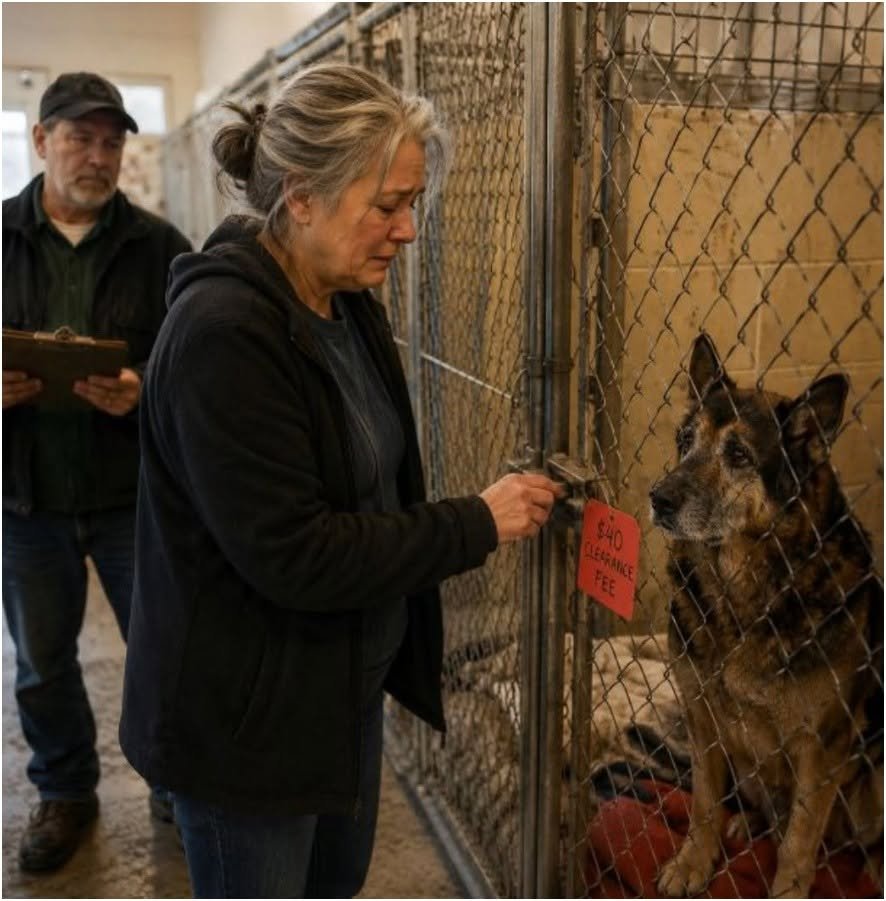
The next morning, I opened the drawer where I kept Orrick’s old red clearance tag.
Thirty-five dollars.
Final review.
I held it in my palm and felt no anger.
Not because it was right.
Because it had been proven wrong so completely that anger no longer owned it.
That tag had not been his ending.
It had been the door.
A month later, Sable called.
“I know it’s too soon,” she said.
“Then why are you calling?”
“Because there’s someone here you should meet.”
I almost said no.
My heart rose up like a wounded animal.
No.
Not again.
Not that pain.
Then I looked at Orrick’s empty bed.
At his leash.
At the sunlight on the floor where he used to sleep.
Love had not made loss easier.
But it had made my life larger.
And a larger life has room for sorrow.
“What’s the name?” I asked.
Sable was quiet for a second.
“Brindle. Twelve-year-old shepherd mix. Bad knees. Owner went into care. She’s been sitting in the back row for three weeks.”
I closed my eyes.
The old fear came.
So did the old ache.
But underneath both, there was something stronger.
Not excitement.
Not replacement.
Purpose.
“I’ll come by after lunch,” I said.
When I arrived, Row Z was still Row Z.
Concrete.
Bleach.
Old blankets.
Hard cases.
But I was not the same woman who had walked there years before with a broken career and an empty calendar.
I knew now that the back row was not where lives ended.
It was where the world’s careless measurements came to be challenged.
Brindle stood when she saw me.
Slowly.
Painfully.
Proudly.
Her muzzle was white.
Her eyes were cautious.
On her kennel door hung a yellow tag.
SENIOR ADOPTION.
I smiled through tears.
“Well,” I whispered, opening my hand for her to smell, “I know something about second chances.”
Behind me, Sable said nothing.
Dat hoefde ze niet.
Buiten, ergens buiten de muren van de schuilplaats, bleef het leven doorgaan.
Jongere honden blaften.
Families lachten.
Telefoons gingen over.
De wereld jaagde op nieuwheid zoals altijd.
Maar in dat laatste kennel stak een oude hond haar neus in mijn handpalm.
En ik voelde Orrick daar.
Niet weg.
Veranderd.
Opgevouwen in elke moedige daad die ik daarna zou doen.
Die middag adopteerde ik Brindle.
Tavian kwam het volgende weekend en bouwde een helling voor de veranda zonder een toespraak te houden.
Calista stuurde een quilt en een briefje met de tekst: « Probeer deze niet te verpesten met sentiment. »
Liora bracht koekjes mee.
Willa Rue, nu ouder, tekende Brindle met een kroon naast Orrick met vleugels.
Ik heb hem op de koelkast geplakt.
Daarna nam ik Orricks rode uitverkooplabel en plaatste het in een klein lijstje bij de voordeur.
Mensen vroegen soms waarom ik iets zo verdrietigs bewaarde waar iedereen het kon zien.
Ik zei dat het niet triest was.
Het was een herinnering.
Een herinnering dat de wereld een leven verkeerd kan prijzen.
Een herinnering dat nut niet hetzelfde is als waarde.
Een herinnering dat tweede kansen vaak mankend komen, met een grijze muilkorf, onhandig en precies op tijd.
En elke ochtend daarna, als Brindle en ik de veranda opstapten, zei ik nog steeds de woorden.
« Perimetercontrole. »
Ze bewoog nooit zoals Orrick.
Ze had haar eigen manier.
Langzamer.
Zachter.
Een beetje scheef.
Maar ze controleerde de tuin met waardigheid.
En ik stond naast haar, een drieënzestigjarige vrouw met grijs haar, rekeningen te betalen, verdriet in haar botten, en meer leven voor haar dan ik ooit voor mogelijk hield.
Het huis aan Briar Hollow Road was niet langer op dezelfde manier stil.
Hij hield blaffen vast.
Voetstappen.
Bezoekers.
Soep waar ik niet om had gevraagd.
Tekeningen op de koelkast.
Een zoon die had geleerd te kloppen voordat hij dingen repareerde.
Buren die de verlichting op de veranda opmerkten.
En een ingelijst rood label bij de deur, die de waarheid beter vertelde dan welke preek ook.
Ze schoten hem op vijfendertig dollar.
Maar Orrick gaf me mijn leven terug.
Tweede kansen maken ons niet weer jong; Ze herinneren ons eraan dat we nog steeds de moeite waard zijn om te kiezen.

